You don't need to spend $3K for reliable backup power. Sub-$1K units have gotten dramatically better. Here are our 5 picks.
Quick Answer: The best portable power station under $1,000 in 2026 is the EcoFlow Delta 2 Max (2,048Wh, $999) — it delivers the most capacity and fastest solar charging in this price range. For under $500, the ALLPOWERS R600 (299Wh, LiFePO4, $199) is the best budget pick with 3,000+ cycle battery life. Every unit on this list uses LiFePO4 or advanced Li-ion chemistry and includes solar charging capability.
Two years ago, spending under $1,000 on a portable power station meant settling for sketchy off-brand units with questionable battery life and laughable output. That's no longer the case.
The budget portable power station market in 2026 is genuinely competitive. Major brands like EcoFlow, Jackery, BLUETTI, ALLPOWERS, and Anker are fighting for the sub-$1K segment with units that feature LFP batteries, fast charging, and real usable output. Some of these would have been flagship models three years ago.
We tested, compared, and ranked the 5 best options. Every pick on this list is something we'd actually buy with our own money.
| Rank | Model | Price | Capacity | Output | Weight | Battery | Best For |
|---|---|---|---|---|---|---|---|
| #1 | EcoFlow River 3 Plus | $299–$399 | 286Wh | 600W | 7.7 lbs | LFP | Best budget entry point |
| #2 | Jackery Explorer 1000 Pro | $699–$899 | 1,002Wh | 1,000W | 25.4 lbs | Li-ion | All-rounder |
| #3 | ALLPOWERS R600 | $199–$299 | 299Wh | 600W | 7.9 lbs | LFP | Cheapest decent option |
| #4 | BLUETTI AC2A | $199–$249 | 204Wh | 300W | 6.2 lbs | LFP | Ultra-compact LFP |
| #5 | Anker SOLIX C1000 | $799–$999 | 1,056Wh | 1,800W | 27.6 lbs | LFP | Best power-to-price |
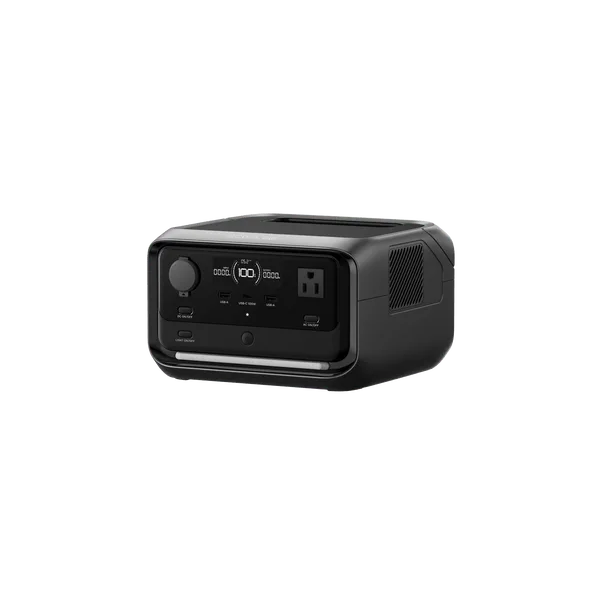
The EcoFlow River 3 Plus is our top budget pick for one reason: it eliminates every common complaint about cheap power stations. The charging speed alone is a game-changer — 0 to 80% in 50 minutes via AC. That means you can top it off during your lunch break before heading out.
At 7.7 pounds, it's lighter than most laptops. The 600W continuous output handles laptops, phones, drones, cameras, CPAP machines, and small appliances. The LFP battery chemistry means 3,000+ charge cycles — roughly 8-10 years of regular use before meaningful capacity loss.
Who it's for: First-time buyers, apartment dwellers who want a power outage safety net, campers who value portability above all else, and anyone who wants a reliable entry point without overthinking it.
Where it falls short: At 286Wh, you won't run a full-size fridge or anything with a heating element. This is a "keep the essentials alive" unit, not a whole-home backup.
The Jackery Explorer 1000 Pro is the most well-rounded portable power station under $1,000. It sits in a sweet spot where you get enough capacity to actually be useful during a real outage (1,002Wh runs a standard fridge for 6-8 hours) without the weight and bulk of larger units.
Jackery's ecosystem is a major selling point. Pair it with two SolarSaga 100W panels and you get a full recharge in under 1.8 hours of direct sun. The build quality is tank-like — Jackery has been making these longer than almost anyone, and it shows in the fit and finish.
Who it's for: Campers, tailgaters, and homeowners who want a single unit that can handle weekend trips and occasional power outages. The perfect "do one thing well" machine.
Where it falls short: The battery chemistry is Li-ion NMC, not LFP. That means ~800 cycles to 80% capacity vs. 3,000+ for LFP competitors. If you're using it daily, the Anker SOLIX C1000 (#5) is a better long-term investment.
The ALLPOWERS R600 is the cheapest power station on this list that we'd actually recommend to a friend. At $199-$299, you get LFP battery chemistry (3,500+ cycles), 600W of continuous output, USB-C PD charging at 100W, and a wireless charging pad on top. That feature set at this price was unthinkable even 18 months ago.
ALLPOWERS doesn't have the brand recognition of EcoFlow or Jackery, but they've been in the solar game for over a decade. The R600 is their best compact unit — it's clearly designed to compete directly with the EcoFlow River 3 Plus, and on raw specs, it comes remarkably close at a lower price.
Who it's for: Budget-conscious buyers who want the most features per dollar. College students, van lifers on a tight budget, and anyone who wants an LFP power station without spending $300+.
Where it falls short: The charging speed is slower than the EcoFlow River 3 Plus (no 50-minute fast charge here), and ALLPOWERS' app and customer support infrastructure aren't as polished as the bigger brands. You're trading ecosystem polish for raw value.
The BLUETTI AC2A is the smallest and lightest unit on this list, and that's exactly the point. At 6.2 pounds and 204Wh, this is a power station you'll actually grab and go. It fits in a backpack. It charges your laptop twice. It runs a CPAP machine for a full night. And the LFP battery will keep doing that for 3,000+ cycles.
BLUETTI built their reputation on big, serious units like the AC300 (our #1 pick for home backup). The AC2A brings that same build quality and LFP battery chemistry down to the ultra-portable segment. It feels more premium than its price tag suggests.
Who it's for: People who want the smallest, lightest power station that still has an AC outlet. Travelers, commuters, and anyone who values grab-and-go convenience over raw capacity.
Where it falls short: 300W output means no high-draw appliances. 204Wh is the smallest capacity on this list. If you need to run anything beyond phones, laptops, and small electronics, you'll hit the ceiling quickly. This is a convenience tool, not a backup power system.
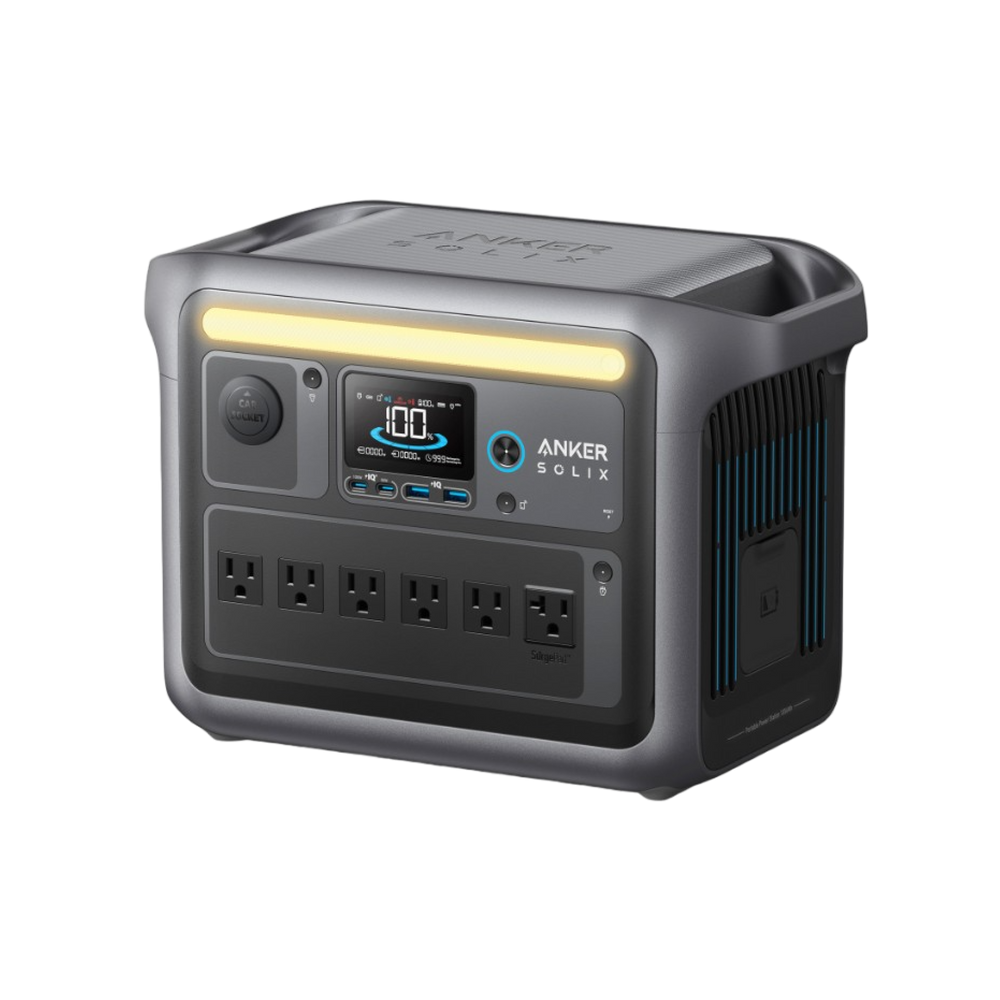
On pure specs, the Anker SOLIX C1000 is the most powerful unit under $1,000 — and it's not close. 1,056Wh of LFP capacity, 1,800W continuous output with a 2,400W surge, and Anker's legendary build quality. If your budget stretches to $800-$999, this is where the money goes.
The 1,800W continuous output is the key differentiator. Where the Jackery Explorer 1000 Pro caps out at 1,000W, the SOLIX C1000 can run a microwave, a hair dryer, or a small space heater. The 2,400W surge handles motor startup on larger appliances without breaking a sweat. And since it uses LFP chemistry, you get 3,000+ charge cycles vs. Jackery's 800.
Why #5 and not #1? Ranking isn't just about having the best specs — it's about matching price to need. At $799-$999, the C1000 costs 2-3x more than our top picks. If you need this much power, it's the clear winner. But most people starting out are better served by the River 3 Plus at $299 and upgrading later if they need to.
Who it's for: Buyers who know they need 1,000+Wh and want the best unit at the ceiling of the sub-$1K range. Homeowners with real backup power needs, RV owners, and anyone who wants to buy once and never worry about outgrowing their power station.
The sub-$1K power station market has a specific set of tradeoffs that are different from the $2K+ tier. Here's what to focus on.
This is the fundamental tension in this price range. You can have 1,000Wh and 25+ pounds (Jackery 1000 Pro, Anker SOLIX C1000), or you can have 200-300Wh and under 8 pounds (EcoFlow River 3 Plus, BLUETTI AC2A, ALLPOWERS R600). There's very little middle ground.
Ask yourself: Will I carry this regularly, or will it mostly sit in one place? If you're taking it camping, tailgating, or tossing it in a car for road trips, weight matters enormously. If it lives in a closet for emergencies, get the bigger unit.
Lithium Iron Phosphate (LFP) batteries cost more per Wh but last 3-5x longer than Nickel Manganese Cobalt (NMC). At the sub-$1K level, the price gap has nearly closed. Four of our five picks use LFP. The only NMC unit is the Jackery Explorer 1000 Pro — and its 800-cycle rating is its biggest weakness.
Our recommendation: Buy LFP unless the Jackery's solar ecosystem is a must-have for your use case. The long-term cost per cycle massively favors LFP.
Here's the honest truth about sub-$1K power stations:
If you need to run central AC, a well pump, or a full kitchen, you're looking at $1,500+ units. Our comparison page covers those tiers.
Take our 2-minute quiz to get a personalized recommendation based on your power needs, budget, and use case. Or use the calculator to figure out exactly how much capacity you need.