We compared capacity, output, battery life, and real-world performance to find the solar generators that keep your home running when the grid goes down.
Quick Answer: The best solar generator for home backup in 2026 is the BLUETTI AC300 + B300 — it delivers 3,000W output with 3,072Wh of LiFePO4 storage, expandable to 12,288Wh for multi-day outages. For a simpler plug-and-play option, the EcoFlow Delta Pro (3,600W, 3,600Wh) offers the highest single-unit capacity. Solar generators cost $1,500–$3,500 vs. $5,000–$15,000 for installed standby generators, require zero fuel, produce no carbon monoxide, and run silently indoors.
In 2024, the average American household experienced over 5.5 hours of power interruption, according to the U.S. Energy Information Administration. That number has been climbing steadily for a decade. NOAA recorded 28 separate billion-dollar weather disasters in the U.S. last year alone — a new record — and each one left thousands to millions of people in the dark for hours, days, or in some cases, weeks.
The math is simple: extreme weather is increasing, the grid is aging, and utilities can't upgrade fast enough. Whether it's a summer derecho in the Midwest, a hurricane along the Gulf Coast, a winter ice storm in the Southeast, or a utility-initiated Public Safety Power Shutoff in California, power outages are no longer rare events. They're seasonal expectations.
That's where a home backup solar generator comes in. We're not talking about powering your entire house like a $15,000 whole-home standby system. We're talking about keeping the essentials alive: your refrigerator (so you don't lose $300+ in food), LED lighting, your internet router and modem, phone and laptop chargers, a CPAP machine if you need one, and maybe a window AC or fan to stay safe during heat events.
A solar generator with 2,000–4,000Wh of battery capacity can keep those critical loads running for 12 to 48 hours depending on your draw — and if you pair it with solar panels, you can ride out a multi-day outage without ever needing gasoline.
We spent weeks comparing the current crop of home backup power stations, looking at real-world capacity, output wattage, battery chemistry, expandability, solar input speed, and long-term value. Below are the five models we'd actually buy with our own money.
Short on time? Here's a summary of all five picks. Click any name to jump to the full breakdown.
| Pick | Capacity | Output | Battery | Price | Best For |
|---|---|---|---|---|---|
| #1 Top Pick BLUETTI AC300 + B300 | 3,072Wh up to 12,288Wh |
3,000W 6,000W surge |
LiFePO4 | $2,599–$3,199 | Overall home backup |
| #2 EcoFlow Delta Pro | 3,600Wh up to 25kWh |
3,600W 7,200W surge |
LiFePO4 | $2,899–$3,499 | Smart home integration |
| #3 Anker SOLIX F3800 | 3,840Wh up to 26.9kWh |
6,000W | LiFePO4 | $3,499–$3,999 | Maximum raw power |
| #4 BLUETTI AC200L | 2,048Wh | 2,400W 3,600W surge |
LiFePO4 | $1,299–$1,599 | Mid-range value |
| #5 EcoFlow Delta 2 Max | 2,048Wh up to 6kWh |
2,400W | LiFePO4 | $1,499–$1,799 | Best under $2K |
Price: ~$2,599–$3,199 (station + 1 B300 battery)
The BLUETTI AC300 is a modular powerhouse that separates the inverter from the battery. The AC300 unit itself has no internal battery — it's a pure inverter/charger that pairs with one or two B300 batteries (3,072Wh each). That modular design means you can start with one battery today and add a second later, scaling from 3,072Wh to 6,144Wh without replacing the entire system. Add a second AC300 with its own batteries and a Fusion Box Pro, and you can bond them for split-phase 240V output and up to 12,288Wh total — enough to rival a small Tesla Powerwall installation.
The 3,000W continuous output handles most critical household loads simultaneously: a full-size refrigerator (150W), a chest freezer (100W), several lights (50W), a router (15W), phone chargers, a laptop, and even a window AC unit (800–1,200W) all at once. The 6,000W surge capacity means it won't trip when your fridge compressor kicks on.
Battery chemistry matters for home backup, and the AC300 uses LiFePO4 (lithium iron phosphate). This chemistry delivers 3,500+ charge cycles before dropping to 80% capacity — that's nearly 10 years of daily use. LFP cells are also inherently more stable than NMC lithium-ion, which means less fire risk and better performance in temperature extremes.
Solar input tops out at 2,400W via the MPPT controller, which means with enough panels you can fully recharge the base 3,072Wh battery in under two hours of peak sun. For extended outages, that recharge speed is the difference between rationing power and living normally.
"The modular design is genius. Started with one B300 and added a second when we needed more capacity. Kept our essentials running for 2 days during Hurricane Ian."
— Verified Buyer
Check Price at BLUETTI Read Full Review

Price: ~$2,899–$3,499
The EcoFlow Delta Pro has established itself as the gold standard for homeowners who want their solar generator to do more than just sit in a closet waiting for an outage. Where the AC300 focuses on modular hardware, the Delta Pro leans into software and smart home integration — and it does it better than anyone else in this class.
The 3,600Wh built-in LiFePO4 battery is larger than the AC300's single B300 module out of the box, and it's expandable up to a remarkable 25kWh with extra batteries and the Smart Home Panel 2. That panel is the Delta Pro's killer feature: it's a dedicated sub-panel that ties directly into your home's electrical system. When the grid drops, it switches to battery power automatically — no extension cords, no manual intervention. You select which circuits to back up (fridge, lights, router) and the system manages the rest.
EcoFlow's app is genuinely excellent. You get real-time monitoring of input/output power, battery state of charge, estimated runtime per circuit, time-of-use programming (charge from the grid when electricity is cheap, discharge during peak rates), and integration with smart home platforms. It's the closest a portable power station gets to behaving like a permanent home battery.
The 3,600W continuous output with 7,200W surge gives it a slight edge over the AC300 for running high-draw appliances. And with 1,600W of solar input, it recharges at a solid clip — though not as fast as the AC300's 2,400W max.
"Seamless switchover during a blackout — didn't even notice the power went out. The app gives you real-time stats on everything."
— Verified Buyer
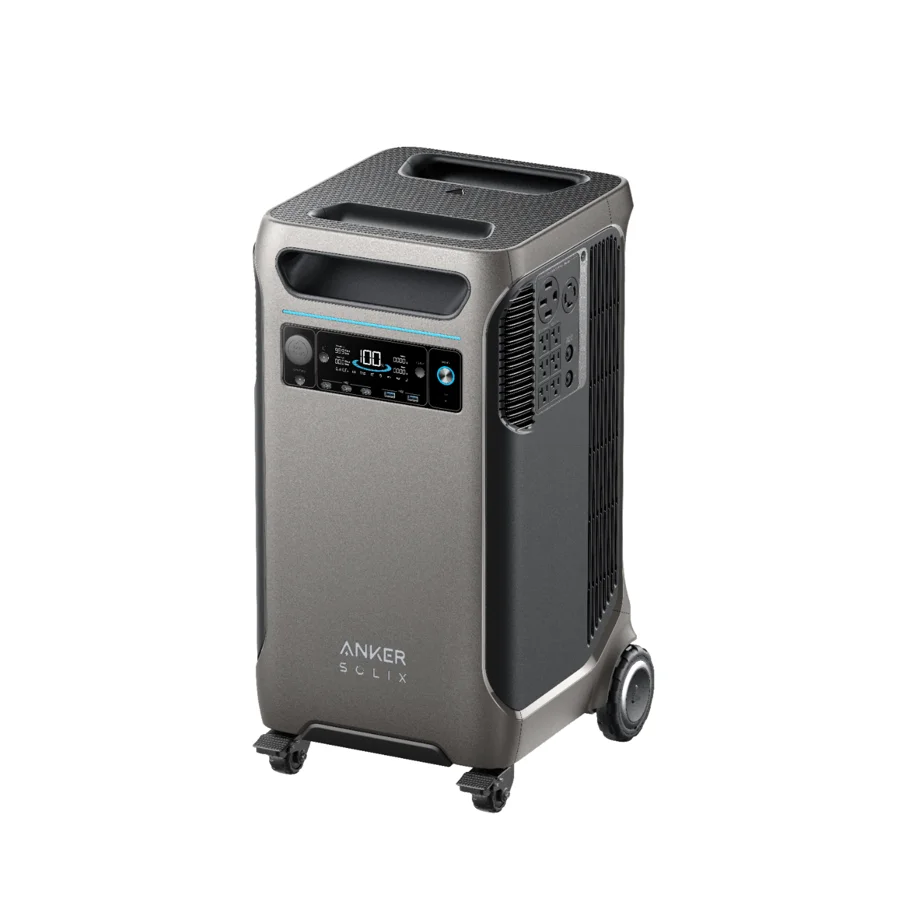
Price: ~$3,499–$3,999
If your priority is running the most demanding appliances during an outage, the Anker SOLIX F3800 is in a class of its own. Its 6,000W continuous output is double what most competitors deliver, and it does so from a single unit — no bonding two systems together like the AC300 requires for similar output.
That 6,000W of continuous power means you can run things other solar generators simply can't handle: a well pump (1,000–2,000W), a large window AC unit or portable AC (1,500W), a full kitchen setup, power tools, and a sump pump all at the same time. For homeowners in rural areas where an outage means losing well water, this is a critical advantage.
The 3,840Wh LiFePO4 battery is the largest base capacity on this list, and it's expandable to 26.9kWh with expansion batteries. Solar input matches the AC300 at 2,400W, so you can fully charge the base battery in under two hours with a strong solar array.
What really sets the F3800 apart for home backup is its transfer switch compatibility. Anker designed this unit to work with a manual or automatic transfer switch, meaning you can wire it into your home's electrical panel for seamless, code-compliant backup. No extension cords. No swapping plugs. When the power goes out, you flip the transfer switch (or it flips automatically) and your selected circuits run on battery.
The trade-off is price and weight. At nearly 132 lbs, this is not something you're taking camping. And starting around $3,499 for the base unit, it's a serious investment. But if you need heavy-duty home backup power and you don't want to bond multiple units together, the F3800 is the most capable single unit you can buy.
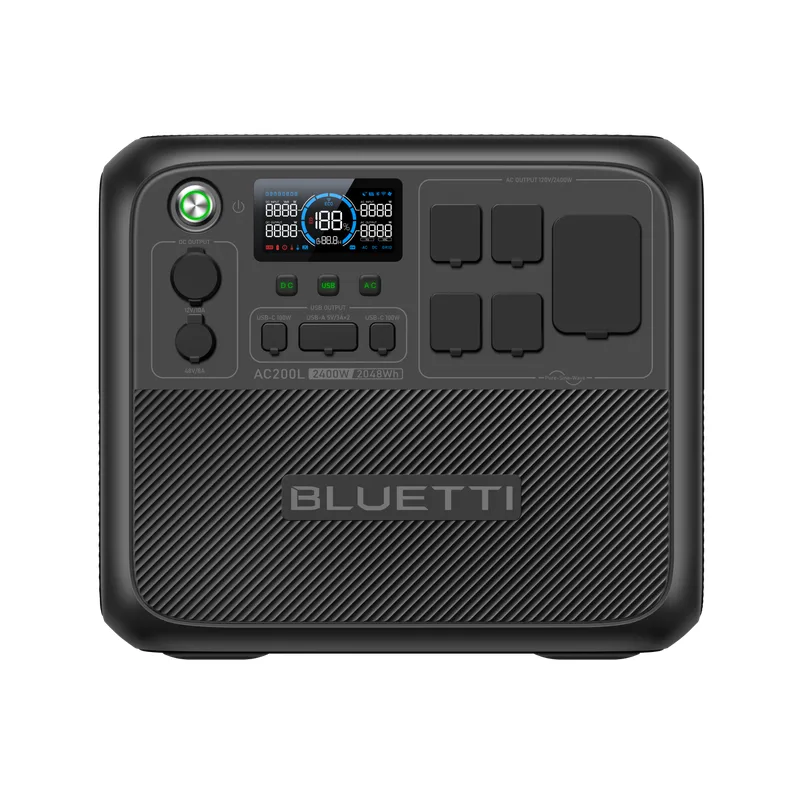
Price: ~$1,299–$1,599
Not everyone needs 3,000+ watts of output or 12kWh of expandable capacity. If you're looking for a solar generator for power outage protection that covers the essentials without breaking the bank, the BLUETTI AC200L delivers an exceptional value proposition.
At 2,048Wh, the AC200L provides enough capacity to run a refrigerator, a few lights, a Wi-Fi router, and charge devices for roughly 10–14 hours on a single charge — enough to get through most outages. The 2,400W continuous output with 3,600W surge is plenty for a fridge, a microwave (short bursts), LED lighting, fans, and a CPAP machine simultaneously.
What makes the AC200L stand out at its price point is BLUETTI's build quality. It uses LiFePO4 battery chemistry just like the AC300, rated for 3,000+ cycles. You're getting the same fundamental reliability and safety as the premium models at roughly half the price.
The AC200L also uses a hybrid battery design that combines LFP cells with a small NMC component. In practice, this means slightly better energy density for the weight (62 lbs — manageable for one person) while retaining the core longevity benefits of LFP chemistry. It supports up to 1,200W of solar input and charges from a wall outlet in about 1.5 hours with the turbo charging mode.
The main limitation is expandability. Unlike the AC300's modular approach, the AC200L is an all-in-one unit. You can add one B300 expansion battery (3,072Wh additional), but the system caps there. If you anticipate needing significantly more capacity down the road, the AC300's open-ended modularity is the better investment. But if 2,048–5,120Wh is enough for your situation, the AC200L saves you hundreds to over a thousand dollars.
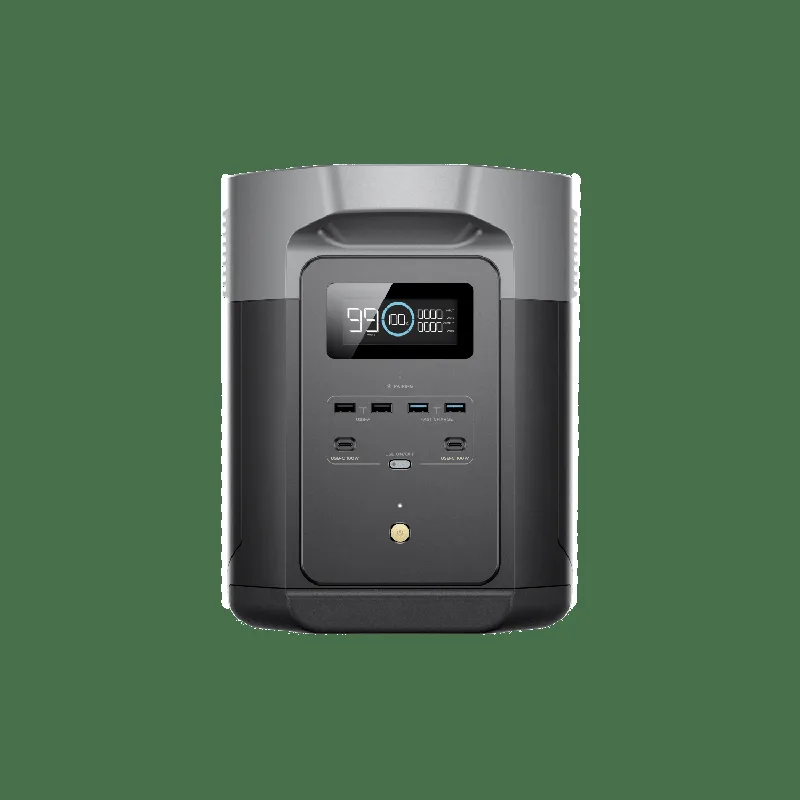
Price: ~$1,499–$1,799
The EcoFlow Delta 2 Max occupies interesting territory. It matches the AC200L on base specs — 2,048Wh capacity, 2,400W output — but differentiates itself in two critical ways: expandability and recharge speed.
You can add up to two expansion batteries to reach 6,144Wh total, giving you nearly the same capacity as a single-battery AC300 setup but with a path to more. That expansion flexibility makes the Delta 2 Max a better long-term investment for homeowners who might start small but want to scale up over time.
But the Delta 2 Max's standout feature is its charge speed. EcoFlow's X-Stream technology charges this unit from 0 to 80% in just 43 minutes via a standard wall outlet. That's the fastest AC recharge of any unit on this list by a significant margin. In a home backup scenario, this speed matters more than you'd think: if the power flickers back on for an hour between outage waves (common during storms), you can recover most of your capacity in that window. Other units would barely reach 30–40%.
The Delta 2 Max also benefits from EcoFlow's excellent app ecosystem. While you don't get the full Smart Home Panel integration that the Delta Pro offers, you still get real-time monitoring, charge scheduling, and firmware updates. Solar input caps at 1,000W — the lowest on this list — but the blistering AC recharge speed compensates for most scenarios.
At 51 lbs, the Delta 2 Max is also the most portable unit on this list. It's a genuine dual-use product: home backup during storm season, camping/tailgate companion the rest of the year.
Spec sheets can be overwhelming. Here's what actually matters when you're buying a home backup power station, and how to figure out what size you need.
Capacity is measured in watt-hours (Wh) and tells you how long the generator can run your devices. Here's how to calculate what you need:
For most households, 2,000–4,000Wh covers critical loads for 12–24 hours. If you want multi-day coverage without solar recharging, look at expandable systems that can reach 6,000–12,000Wh.
Output wattage determines what you can run simultaneously. Your total wattage draw at any moment must be less than the generator's continuous output rating. Pay special attention to surge (peak) wattage — appliances with motors (fridges, AC units, pumps) draw 2–3x their running wattage for a few seconds at startup. If your generator's surge rating can't handle the spike, it will trip the overload protection and shut down.
For home backup essentials, 2,400W continuous is usually sufficient. If you need to run a window AC unit alongside other loads, look for 3,000W+. For well pumps or heavy power tools, you'll want the 6,000W class.
All five picks on this list use LiFePO4 (lithium iron phosphate), and that's intentional. Compared to the NMC (nickel-manganese-cobalt) lithium-ion found in cheaper generators:
If you see a solar generator priced suspiciously low, check the battery chemistry. NMC units are cheaper upfront but cost more per cycle over their lifetime.
Modular systems (AC300, Delta Pro, F3800) let you add batteries later as your needs grow or budget allows. Single-unit systems (AC200L) are cheaper but cap your total capacity. If you're uncertain about your long-term needs, modular is worth the premium.
Higher solar input wattage means faster recharging during extended outages. The AC300 and F3800 lead at 2,400W, which can fully recharge their base batteries in under 2 hours of peak sun with enough panels. Lower input (1,000W) means 4–5 hours for the same capacity. For a detailed sizing breakdown, try our solar calculator.
A transfer switch connects your solar generator directly to your home's electrical panel, eliminating extension cords. The F3800 and Delta Pro (with Smart Home Panel) support this. It's the most seamless backup experience, but installation typically requires an electrician ($200–$500).
Home backup units are heavy (51–132 lbs). If you need to move it between floors or use it for camping too, weight matters. The Delta 2 Max (51 lbs) is the most portable. The F3800 (132 lbs) essentially needs a permanent spot.
Not sure what size is right for you? Our spec guide breaks down capacity tiers by household size, or take the 2-minute generator quiz for a personalized recommendation.
Free Download
Get our free Solar Generator Buyer's Guide — 47 pages, real specs, no fluff. We'll send it straight to your inbox.
No spam. Unsubscribe anytime.
It depends on your battery capacity and what you're running. A 3,000Wh unit powering a fridge (150W), router (15W), a few LED lights (30W), and phone chargers (20W) — about 215W total — will last roughly 12–14 hours. The same battery running a window AC unit (1,200W) will drain in about 2.5 hours. To estimate your runtime, divide your battery's usable capacity (typically 90% of rated Wh for LiFePO4) by your total wattage draw. Our solar calculator can run these numbers for you automatically.
Most portable solar generators cannot run central AC, which typically requires 3,000–5,000W starting power and 15–20A at 240V. The Anker SOLIX F3800 (6,000W) and the BLUETTI AC300 in split-phase mode (240V capable) can theoretically handle smaller central units, but runtime will be very short. For extended outages, a solar generator is better used to run a window AC unit or mini-split in one room while keeping essentials alive elsewhere. If central air is a requirement, you're likely looking at a whole-home standby generator or a permanent battery system like the Tesla Powerwall.
For most homeowners, yes — especially compared to the alternatives. A traditional standby generator costs $5,000–$15,000 installed, requires gas or propane, needs annual maintenance, and produces carbon monoxide (meaning it must stay outside). A solar generator in the $1,500–$3,500 range requires zero fuel, produces no emissions, runs silently, works safely indoors, and can recharge from solar panels during extended outages. The trade-off is lower total output and finite runtime, but for keeping critical loads running for 12–48 hours, solar generators are the most practical option for the majority of households. Check our full comparison to see how different models stack up for your needs.
Solar panels are the primary method. Most home backup generators accept 400–2,400W of solar input. With 400W of panels (two 200W panels, roughly $400–$600), you can add about 2,000–2,400Wh back per day in good sun conditions — enough to keep running essentials indefinitely. Other options include car charging via a 12V adapter (slower, typically 100–200W) or a gas generator feeding into the solar generator's AC input if solar conditions are poor. For maximum resilience during multi-day outages, we recommend at least 400W of solar panels as a minimum, and 800W+ for households running higher loads.
Use our free tools to find your perfect match — no guesswork, no pressure.
Calculate Your Power Needs Take the 2-Min Quiz Or compare all models side by side →