From the 8.4 lb RIVER 3 Plus to the whole-home-scale DELTA Pro Ultra, we ranked EcoFlow's entire 2026 lineup by real-world value, output, and use case — so you don't have to guess which one fits your life.
Quick Answer: The best EcoFlow solar generator depends on your use case. For camping and light backup, the RIVER 3 Plus ($299) offers the best portability. For home backup and RV use, the Delta 2 Max ($1,499) delivers the best value with 2,048Wh LiFePO4 and 2,400W output. For whole-home backup and off-grid living, the Delta Pro ($2,699) with 3,600Wh and expandable to 25kWh is the top pick. All 2026 models use LiFePO4 chemistry with 3,000+ cycle lifespans.
EcoFlow makes more solar generators than almost any other brand on the market, and the lineup spans a genuinely wide range — from a $299 unit you can carry in one hand to a modular home-battery system that scales past 90kWh. That range is a strength, but it also makes "which EcoFlow should I buy?" a harder question than it looks.
We didn't rank these five models on spec sheets alone. Every EcoFlow generator claims impressive numbers; the question is which numbers actually matter for how you'll use the thing. We weighed five factors:
The result is a ranking built around fit, not just horsepower. The DELTA Pro Ultra has the biggest numbers on this list, but it's not automatically the "best" EcoFlow — it's the best EcoFlow if you're replacing a home battery or running a construction site. For most people reading this, that's not the case, which is why our #1 overall pick is the mid-range DELTA 2 Max, not the flagship. Below, we rank all five by where each one genuinely earns its price.
Short on time? Here's every current EcoFlow model side by side. Jump to any section below for the full breakdown.
| Rank | Model | Capacity | Output | Solar Input | Weight | Price |
|---|---|---|---|---|---|---|
| #1 Top Pick | DELTA 2 Max | 2,048Wh | 2,400W (5,000W surge) | 1,000W | 48.1 lbs | ~$1,499 |
| #2 | DELTA Pro | 3,600Wh | 3,600W (7,200W surge) | 1,600W | 99 lbs | ~$2,699 |
| #3 | RIVER 3 Plus | 286Wh | 600W (1,200W surge) | 220W | 8.4 lbs | ~$299 |
| #4 | DELTA 2 | 1,024Wh | 1,800W (2,700W surge) | 500W | 27.5 lbs | ~$699–$799 |
| #5 | DELTA Pro Ultra | 6,144Wh per unit |
7,200W | 5,600W | 70 lbs (inverter) + 111.8 lbs (battery) |
~$5,799+ |
All five run LiFePO4 (lithium iron phosphate) cells rated for 3,000 or more charge cycles — a meaningful upgrade over the NMC chemistry still common in budget power stations. If you're not sure how to translate any of these numbers into "how long will this run my stuff," our sizing guide walks through the math.
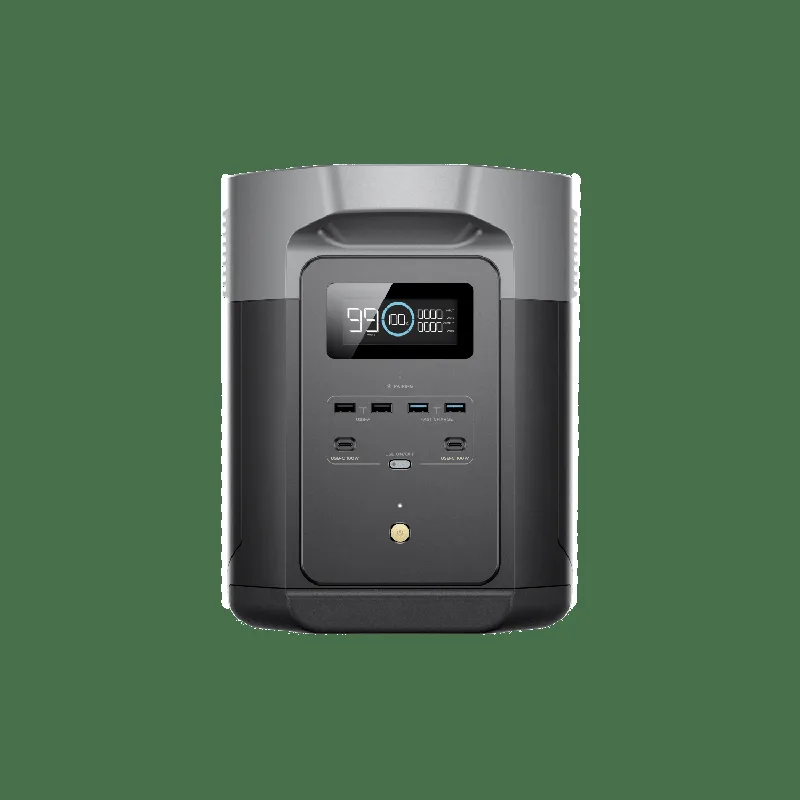
Price: ~$1,499 • Expandable to: 6,144Wh
If you only read one section of this guide, make it this one. The DELTA 2 Max is the model we'd recommend to the widest range of buyers, and it's our top pick in this lineup for a simple reason: it delivers the highest percentage of the flagship DELTA Pro's real-world capability at roughly 55% of the price.
The 2,048Wh LiFePO4 battery and 2,400W output (5,000W surge) comfortably run a full-size refrigerator, LED lighting, a router, laptops, and a CPAP machine simultaneously — the exact mix of loads most households actually need during an outage. The 5,000W surge rating handles compressor startup on fridges and freezers without tripping, which is where cheaper units in this capacity range often fall short. A 43-minute 0–80% AC fast charge means you can sprint to nearly full before a storm hits, and 1,000W of solar input keeps it topped off indefinitely if the outage runs long.
It's also expandable — up to 6,144Wh with add-on batteries — so you're not boxed into today's capacity if your needs grow. At 48.1 lbs, it's the rare unit in this class that one person can still move between the garage, a vehicle, and a campsite without a hand truck.
We've tested this unit extensively; read the full DELTA 2 Max review for detailed runtime tests, solar charging benchmarks, and a head-to-head against the BLUETTI AC300 and Jackery Explorer 2000 Plus.
"Ran my entire house during a 3-day outage — fridge, lights, WiFi, phone chargers. Never dropped below 40%."
— Verified Buyer
Check Price at EcoFlow Read Full Review

Price: ~$2,699 • Expandable to: 25kWh with Smart Home Panel
Step up from the DELTA 2 Max when your needs cross from "keep the essentials alive" into "back up most of the house." The DELTA Pro's 3,600Wh base capacity and 3,600W output (7,200W surge) handle heavier simultaneous loads — a window AC unit, a microwave, and a fridge running together, for example — without hitting the ceiling that trips smaller units.
What actually separates the DELTA Pro from the rest of this lineup is the optional Smart Home Panel 2 integration. It's a dedicated sub-panel that wires into your home's electrical system and automatically switches to battery power when the grid drops, no extension cords or manual plug-swapping required. You choose which circuits it backs up, and EcoFlow's app gives you real-time monitoring of each one. Paired with expansion batteries, the system scales all the way to 25kWh — enough for multi-day whole-home coverage in most climates.
At 99 lbs, this is not a unit you're moving casually; it's meant to live in a garage, utility closet, or basement as a semi-permanent fixture. If that matches how you plan to use it — a homeowner or off-grid cabin owner wanting serious backup capacity without a $10,000+ installed battery system — the DELTA Pro is the strongest fit in EcoFlow's lineup. It's our top pick specifically for whole-home and off-grid cabin use, edging out the smaller units on raw output and the DELTA Pro Ultra on price-to-capability for most households.
"Installed this as my home backup after Hurricane Ian. It powered my medical equipment for 18 hours straight."
— Verified Buyer
Check Price at EcoFlow See Home Backup Rankings
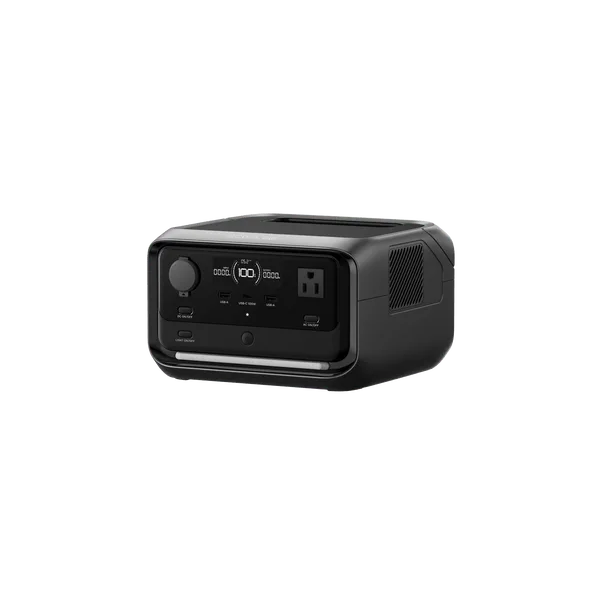
Price: ~$299 • Expandable: No
Not every buyer needs 2,000+ watt-hours. If you just want reliable power for phones, a laptop, a camp light, and maybe a mini fridge or fan, the RIVER 3 Plus is the most sensible EcoFlow to own — and at $299, it's the cheapest way into LiFePO4 chemistry in the entire lineup.
At 8.4 lbs, this is genuinely a "toss it in a backpack" unit, unlike everything else on this list. The 600W output (1,200W surge via X-Boost mode) covers small appliances, a coffee maker on the lower end, or a portable fan and lights running for a full weekend. It won't run a full-size fridge or a space heater for long, but that's not the job it's built for.
The 220W solar input is modest but appropriately scaled — a single 100–200W folding panel keeps it topped off during a multi-day camping trip. It also charges fast from a wall outlet (under an hour for a full charge), so it's equally useful as a always-charged grab-and-go unit for short power blips at home.
Check Price at EcoFlow See Best Camping Picks

Price: ~$699–$799 • Expandable to: 3,072Wh
The standard DELTA 2 sits in the gap between the RIVER 3 Plus and the DELTA 2 Max, and for a specific type of buyer, that gap is exactly where they need to be. It's roughly double the RIVER 3 Plus's capacity and output at a still-approachable price, while costing about half of what the DELTA 2 Max runs.
1,024Wh and 1,800W (2,700W surge) is enough to run a weekend of camping loads — a 12V fridge, lights, fans, device charging, and an electric kettle or small hot plate — without the weight or price of the larger DELTA models. At 27.5 lbs, it's still light enough for one person to carry, but with meaningfully more headroom than the RIVER 3 Plus for anything beyond phones and laptops.
It's also expandable to 3,072Wh with a single add-on battery, which gives it more long-term flexibility than the RIVER line if your needs grow gradually. The 500W solar input is double the RIVER 3 Plus's ceiling, meaning a modest two-panel setup can fully recharge it in a few hours of good sun. The trade-off versus the DELTA 2 Max is straightforward: half the capacity and output for roughly half the price. If your loads genuinely fit within 1,800W and you don't need home-backup-grade capacity, that trade is a good one.
Check Price at EcoFlow See RV & Van Life Picks
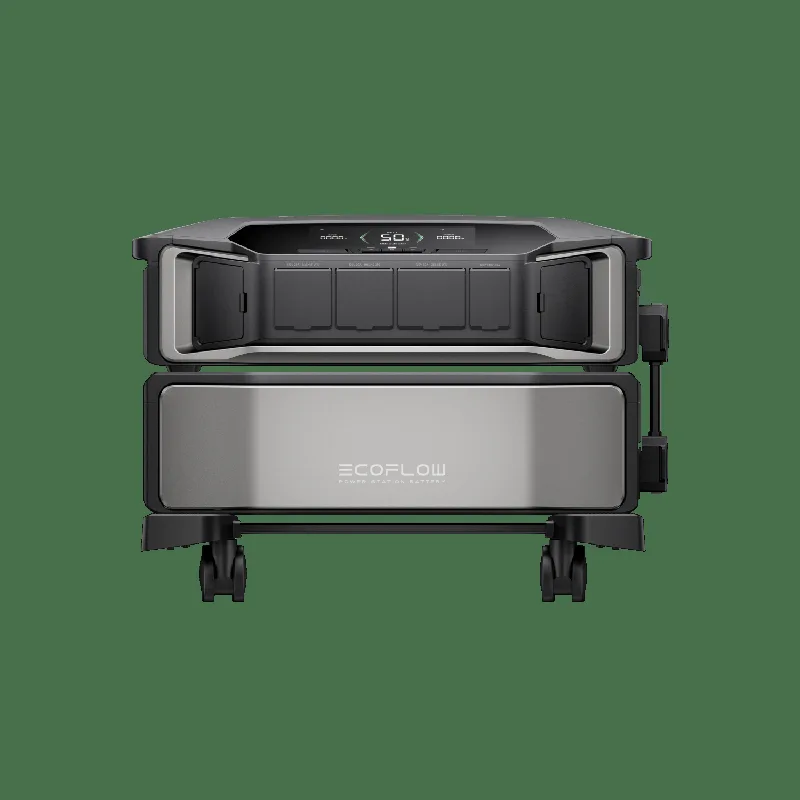
Price: ~$5,799+ • Expandable to: 90kWh
The DELTA Pro Ultra is EcoFlow's answer to "what if a portable power station tried to replace a home battery entirely." It's a modular inverter-plus-battery system: a 70 lb inverter capable of 7,200W continuous output (pure sine wave, up to 10.8kW peak) paired with 111.8 lb battery modules at 6,144Wh each. Stack up to five batteries per inverter and you're at 30.7kWh; link multiple inverters and the system scales to 90kWh — genuinely competitive with a small Tesla Powerwall installation.
The 5,600W solar input (via High and Low-PV inputs) is the highest in EcoFlow's lineup by a wide margin, and it matters: with a serious rooftop or ground-mount array, you can recharge a full battery module in a couple of hours of strong sun, which is the difference between rationing power during an extended outage and living close to normally. Fast charging tops out at 8,800W from mixed AC and solar input, EcoFlow's quickest across the board.
This is not a casual purchase, and it's not meant to be. It integrates with home panels for permanent installation, supports generator-style backup for construction sites and off-grid builds, and is priced and sized accordingly. If you're comparing it to whole-home standby generators or a residential battery system, the DELTA Pro Ultra is dramatically more flexible and still meaningfully cheaper than most installed alternatives. If you're comparing it to the DELTA Pro, understand that you're paying a significant premium for scale most households will never fully use.
Check Price at EcoFlow See Off-Grid Living Picks
Still not sure which one fits? Match your situation to the use cases below.
Go with the RIVER 3 Plus ($299). It's the lightest, cheapest way into EcoFlow's LiFePO4 lineup and covers phones, laptops, camp lights, and small electronics for days on end.
Go with the DELTA 2 Max ($1,499). It's our overall top pick — enough capacity and output to run a fridge, router, and laptops through a real outage, with the fastest recharge in this price tier.
Go with the DELTA Pro ($2,699). Smart Home Panel 2 integration and expansion up to 25kWh make it the strongest fit for homeowners who want serious, code-friendly backup capacity.
Go with the DELTA 2 ($699–$799). It splits the difference between the RIVER 3 Plus and DELTA 2 Max for buyers who need more than ultralight but don't need home-backup-grade capacity.
Go with the DELTA Pro Ultra ($5,799+). Modular scaling to 90kWh and 5,600W solar input make it the closest thing to a residential battery system EcoFlow sells.
Still torn between models? Take our 2-minute generator quiz for a personalized recommendation, or use the full comparison tool to see every spec side by side.
EcoFlow isn't the only serious option in the solar generator market. Here's how our top EcoFlow pick, the DELTA 2 Max, stacks up against the models buyers most often cross-shop.
| Spec | EcoFlow DELTA 2 Max | BLUETTI AC300 + B300 | Jackery Explorer 2000 Plus | ALLPOWERS R3500 |
|---|---|---|---|---|
| Price | $1,499–$1,799 | $2,599–$3,199 | $1,899–$2,199 | $1,899–$2,199 |
| Battery | 2,048Wh LiFePO4 | 3,072Wh LiFePO4 | 2,042Wh LiFePO4 | 3,168Wh LiFePO4 |
| AC Output | 2,400W | 3,000W | 3,000W | 3,200W |
| Solar Input | 1,000W | 2,400W | 1,200W | 1,800W |
| AC Charge Speed | ~75 min (0–100%) | ~80 min | ~2 hours | ~2 hours |
| Cycle Life | 3,000+ | 3,500+ | 3,000+ | 3,000+ |
The BLUETTI AC300 is the more capable modular system — more output, more than double the solar input, and 240V split-phase capability — but it costs $1,000–$1,400 more and weighs nearly three times as much fully configured. See our full BLUETTI AC300 vs. EcoFlow Delta Pro comparison for the deeper breakdown.
The Jackery Explorer 2000 Plus is EcoFlow's closest direct competitor at a nearly identical capacity, and it wins on output and solar input. The DELTA 2 Max wins on price, weight, and by far the fastest AC recharge. For most buyers, the price and charging speed advantage tips the scale toward EcoFlow.
The ALLPOWERS R3500 offers more raw capacity and solar input for similar money, and it's worth a look if solar recharge speed matters more to you than EcoFlow's ecosystem and app polish. Where EcoFlow tends to win is fit and finish, app experience, and resale/support ecosystem — ALLPOWERS wins on pure spec-per-dollar in this comparison.
Free Download
Get our free Solar Generator Buyer's Guide — 47 pages, real specs, no fluff. We'll send it straight to your inbox.
No spam. Unsubscribe anytime.
It depends on your use case. For camping, road trips, and light backup, the RIVER 3 Plus ($299) is the best value at 8.4 lbs. For home backup, RV use, and remote work, the DELTA 2 Max ($1,499) offers the best balance of capacity, output, and price with 2,048Wh and 2,400W. For whole-home backup and off-grid cabins, the DELTA Pro ($2,699) delivers 3,600Wh and expands to 25kWh with a Smart Home Panel. For weekend camping and light home backup on a mid-range budget, the DELTA 2 ($699–$799) fills the gap. For a permanent home battery replacement or full off-grid living, the DELTA Pro Ultra ($5,799+) scales to 90kWh. Take our 2-minute quiz for a personalized recommendation.
The RIVER line is EcoFlow's compact, ultralight series, built for portability over raw capacity. The RIVER 3 Plus weighs just 8.4 lbs and holds 286Wh — enough for phones, laptops, and small electronics, but not appliances. The DELTA line is EcoFlow's home-backup and heavy-duty series, ranging from the entry-level DELTA 2 (1,024Wh, 1,800W) up through the DELTA 2 Max, DELTA Pro, and DELTA Pro Ultra (6,144Wh per unit, expandable to 90kWh). If you need to run a refrigerator, power tools, or your home's essential circuits, you want a DELTA. If you just need to keep small devices charged on the go, RIVER is lighter and cheaper.
For anything beyond light camping, yes. The DELTA 2 Max roughly doubles the DELTA 2's capacity (2,048Wh vs. 1,024Wh) and output (2,400W vs. 1,800W), and both use LiFePO4 chemistry rated for 3,000+ cycles. The DELTA 2 Max also charges faster from a wall outlet and accepts twice the solar input (1,000W vs. 500W). The standard DELTA 2 is still a solid choice if your budget is under $800 and your needs are limited to weekend camping, tailgating, or light backup for a few devices. For home backup or extended off-grid use, the DELTA 2 Max is worth the extra cost. Read the full DELTA 2 Max review for detailed test results.
Solar input scales with each model's size: the RIVER 3 Plus accepts up to 220W, the DELTA 2 accepts up to 500W, the DELTA 2 Max accepts up to 1,000W, the DELTA Pro accepts up to 1,600W, and the DELTA Pro Ultra accepts up to 5,600W across its High and Low-PV inputs. Higher solar input means faster recharging during extended outages or off-grid stretches — the DELTA Pro Ultra can theoretically recharge a full battery module in a few hours of strong sun, while the RIVER 3 Plus is built more for AC wall charging or lighter panel setups. Use our sizing guide to match panel wattage to your generator.
Yes. Every model in EcoFlow's current 2026 lineup — RIVER 3 Plus, DELTA 2, DELTA 2 Max, DELTA Pro, and DELTA Pro Ultra — uses LiFePO4 (lithium iron phosphate) battery chemistry, rated for 3,000 or more charge cycles to 80% capacity. That's a meaningful upgrade over older NMC lithium-ion cells, which typically last only 500–800 cycles. LiFePO4 is also more thermally stable, making it safer for daily use, vehicle storage, and hot climates.
Take our 2-minute quiz for a personalized pick, or compare every EcoFlow model against the rest of the market side by side.
Take the 2-Min Quiz Or compare all models side by side →47 pages. Plain English. No fluff. Covers every major brand, real-world runtime tests, and our top picks for every budget.
No spam. Unsubscribe anytime. We hate junk mail as much as you do.