LiTime is the #1 budget LiFePO4 brand — 4,000+ cycle life, self-heating models, Bluetooth monitoring, and prices 40–60% below Dakota Lithium and Battle Born. We ranked their full 12V lineup for solar, RV, marine, and off-grid use.
Quick Answer: The best LiTime battery for most solar setups is the 12V 100Ah ($335.99) — 1,280Wh of usable LiFePO4 capacity, 4,000+ cycle life, 100A BMS, IP65 rated, 24.25 lbs, and a 5-year warranty. For larger systems, the 12V 300Ah ($599.99) delivers 3,840Wh in a single unit — more total capacity than a Dakota Lithium 200Ah ($1,449) at 59% less cost. Compared to Dakota Lithium ($749/100Ah) and Battle Born ($949/100Ah), LiTime saves $413–$613 per battery with double the rated cycle life. The trade-off: shorter warranty (5 years vs 10–11) and less extreme cold tolerance (14°F vs −20°F).
The LiFePO4 battery market has a dirty secret: most of the premium-priced batteries use cells from the same Chinese factories. Dakota Lithium, Battle Born, Renogy, and LiTime all source LiFePO4 prismatic cells from a handful of major manufacturers. The difference is branding, BMS design, warranty policy, and markup.
LiTime (formerly Ampere Time) is based in Shenzhen, China, with US warehouses in California and Texas. They’ve sold over 10 million battery units worldwide since 2016, making them one of the highest-volume LiFePO4 brands on the planet. Their strategy: strip the premium markup, ship directly to consumers through Amazon and their own site, and let the price-to-performance ratio speak for itself.
Three things differentiate LiTime from the premium brands:
The trade-offs: LiTime’s 5-year warranty is shorter than Dakota Lithium’s 11-year and Battle Born’s 10-year. Their cold-weather discharge floor is 14°F vs Dakota Lithium’s −20°F. And support routes through Shenzhen, not a US office. If you live in extreme cold, need the longest warranty, or want US phone support — pay the premium for Dakota Lithium. For everyone else, LiTime delivers the same core technology for significantly less money.
| Rank | Model | Capacity | Wh | Weight | Cycles | Price |
|---|---|---|---|---|---|---|
| #1 Best Value | 12V 100Ah | 100Ah | 1,280Wh | 24.25 lbs | 4,000+ | $335.99 |
| #2 Best Mid-Range | 12V 200Ah Xtra Mini | 200Ah | 2,560Wh | 44.5 lbs | 6,000+ | $679.99 |
| #3 Best Capacity | 12V 300Ah | 300Ah | 3,840Wh | 62.8 lbs | 4,000+ | $599.99 |
| #4 Best Cold Climate | 12V 320Ah Self-Heating | 320Ah | 4,096Wh | ~70 lbs | 4,000+ | $859.99 |
All LiTime batteries use Grade A LiFePO4 prismatic cells with built-in BMS (Battery Management System) for overcharge, over-discharge, short circuit, over-current, and temperature protection. All carry a 5-year warranty. All support parallel and series wiring up to 4P4S configurations.
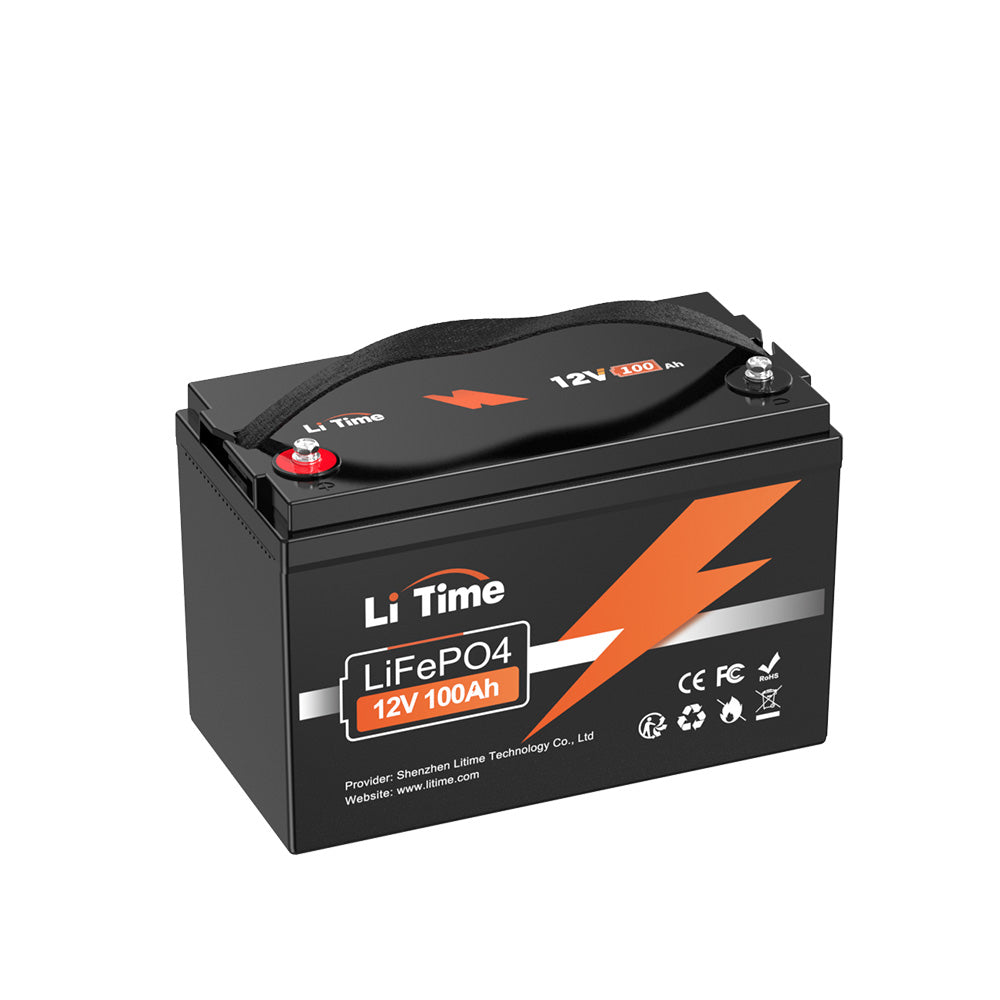
Price: $335.99 • Chemistry: LiFePO4 • BMS: 100A Built-in • Dimensions: 13"×6.77"×8.43" • IP Rating: IP65 • Warranty: 5 years
This is where most buyers should start. The 100Ah is LiTime’s best-selling battery and the most cost-effective entry into LiFePO4 solar storage on the market. At $335.99, it costs less than half of a Dakota Lithium 100Ah ($749) and delivers the same 1,280Wh of usable capacity. The math is simple: for the price of one Dakota Lithium, you can buy two LiTime batteries and have 2,560Wh of storage — plus $77 left over.
At 24.25 lbs, it’s half the weight of Dakota Lithium’s 100Ah (50 lbs) and slightly lighter than Renogy (24.2 lbs). The built-in 100A BMS handles overcharge, over-discharge, short circuit, and temperature protection automatically. IP65 weather resistance means it can handle rain, dust, and outdoor installations without a dedicated enclosure.
For solar use: pair with a 200W panel and an MPPT charge controller set to LiFePO4 profile (14.6V absorption, 13.6V float). Full recharge from 20% to 100% in 5–6 hours of good sun. Daily cycling at 80% depth of discharge gives you 10+ years of service life before the battery drops below 80% original capacity.
The comparison that matters: A LiTime 100Ah ($335.99) vs. a Dakota Lithium 100Ah ($749). Same chemistry, same voltage, same 1,280Wh. LiTime is lighter (24.25 vs 50 lbs), has more rated cycles (4,000+ vs 2,000+), and costs 55% less. Dakota Lithium wins on cold discharge (−20°F vs 14°F) and warranty (11 years vs 5 years). For warm and moderate climates, LiTime is the rational choice.
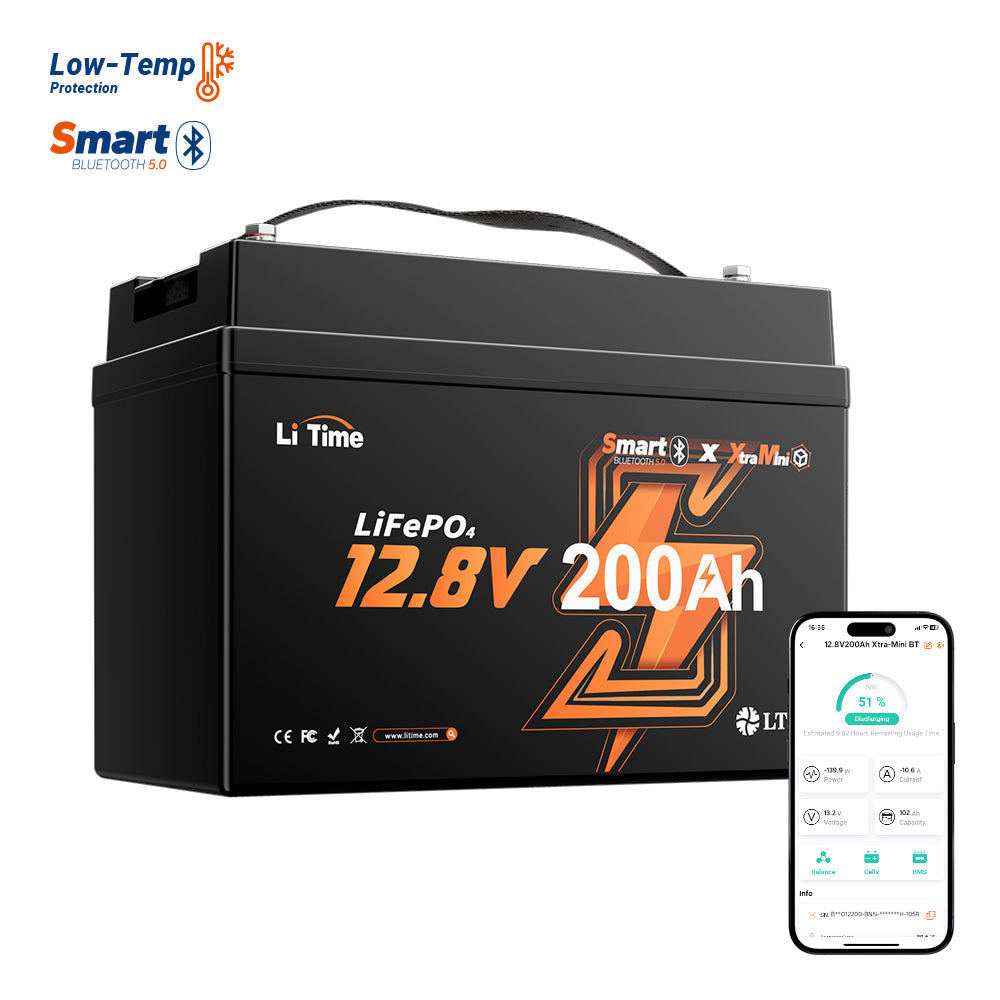
Price: $679.99 • Chemistry: LiFePO4 • BMS: 200A Built-in • Dimensions: 13.11"×6.93"×9.45" • Bluetooth: 5.0 • IP Rating: IP65 • Warranty: 5 years
The 200Ah Xtra Mini is LiTime’s sweet spot for serious solar builders. “Xtra Mini” means compact form factor — at 13.11"×6.93"×9.45" and 44.5 lbs, it packs 2,560Wh into roughly the same footprint as a standard Group 31 battery. That’s the same capacity as Dakota Lithium’s 200Ah ($1,449) for 53% less money.
The standout spec here is 6,000+ rated cycles — the highest in LiTime’s lineup and significantly more than any competitor at this price point. At daily cycling, that translates to 16.4+ years of service life. The 200A BMS handles higher continuous loads, and built-in Bluetooth 5.0 connects to the free LiTime app for real-time monitoring of voltage, current, temperature, state of charge, and lifetime cycle count.
For solar use: pair with 400W of panels and a 30A+ MPPT controller. Full recharge from 20% in 5–6 hours. This single battery powers a fridge (150W), LED lights (20W), phone charging (10W), and a Wi-Fi router (15W) for 13+ hours during an outage — all for $679.99.
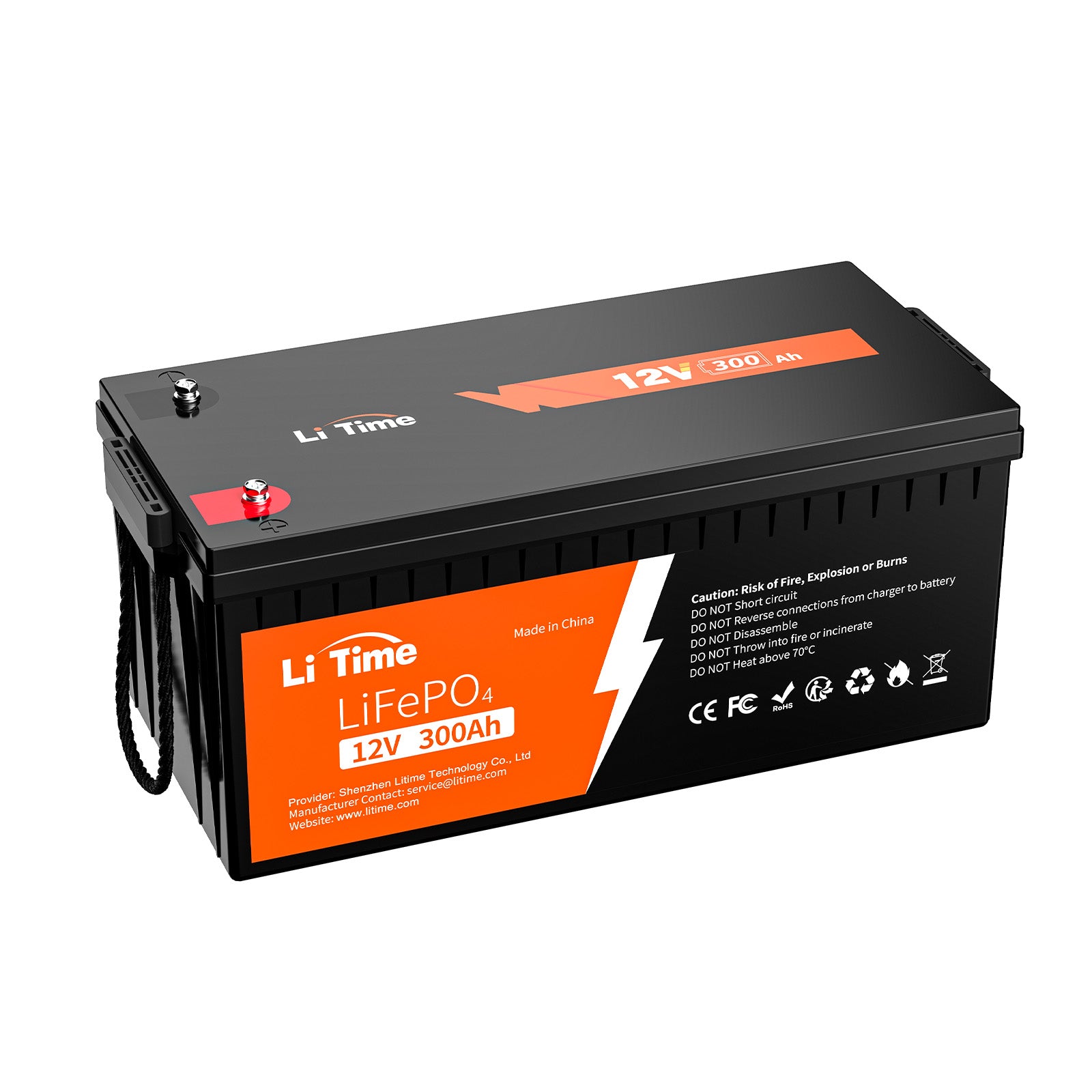
Price: $599.99 • Chemistry: LiFePO4 • BMS: 200A Built-in • Dimensions: 20.55"×9.33"×8.58" • Certification: UL-1973 • Warranty: 5 years
The 300Ah is LiTime’s highest-capacity single battery — 3,840Wh in a single unit. That’s more total energy than a Dakota Lithium 200Ah (2,560Wh) and nearly 50% more capacity, for $599.99 vs $1,449. In terms of raw capacity per dollar, this is the best deal in the entire LiFePO4 market.
The math: 3,840Wh at $599.99 = $0.156 per watt-hour. Compare that to Dakota Lithium’s $0.566/Wh (200Ah), Battle Born’s $0.742/Wh (100Ah), or even LiTime’s own 100Ah at $0.263/Wh. The 300Ah is the most efficient way to build a large battery bank.
It carries UL-1973 certification — the most rigorous safety standard for stationary energy storage batteries, covering fire, electrical, and environmental testing. This matters for insurance, permitting, and peace of mind in permanent installations. The 200A BMS handles high continuous loads, and 4,000+ rated cycles give you 10.9+ years of daily cycling.
For solar use: pair with 600W+ of panels and a 40A+ MPPT controller. A single 300Ah battery powers essential home circuits (fridge, lights, router, devices) for 19+ hours during an outage. Two in parallel give you 7,680Wh for $1,199.98 — a full day of off-grid living for most households.
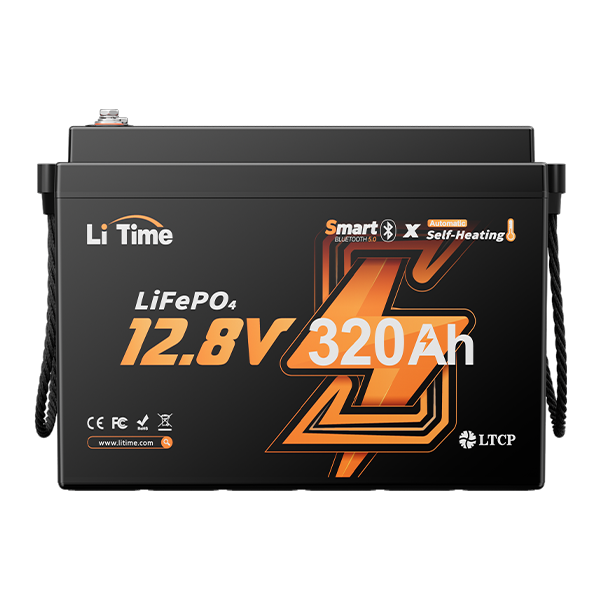
Price: $859.99 • Chemistry: LiFePO4 • Self-Heating: Activates < 41°F • Bluetooth: 5.0 • Warranty: 5 years
The 320Ah Self-Heating solves the biggest problem with budget LiFePO4 batteries: cold-weather charging. LiFePO4 batteries cannot be safely charged below 32°F — doing so causes permanent lithium plating on the anode, reducing capacity and creating safety risks. Dakota Lithium avoids this by rating discharge to −20°F (but still limits charging to 32°F). LiTime’s answer: build the heater directly into the battery.
When the internal temperature drops below 41°F (5°C), the self-heating element activates automatically using the battery’s own stored energy. It warms the cells to safe charging temperature before allowing current to flow in. No external heating pad needed. No manual intervention. The BMS handles everything.
At 320Ah / 4,096Wh, this is also LiTime’s highest-capacity single-battery option. With Bluetooth 5.0 for real-time monitoring, it’s the complete package for cold-climate solar, RV, and marine installations. At $859.99, it’s still $589 less than Dakota Lithium’s 200Ah ($1,449) while delivering 60% more capacity and built-in cold protection.
This is the comparison every LiFePO4 buyer makes. Here’s how the four major 12V 100Ah batteries stack up:
| Spec | LiTime | Dakota Lithium | Renogy | Battle Born |
|---|---|---|---|---|
| Price (100Ah) | $335.99 | $749 | $450 | $949 |
| Chemistry | LiFePO4 | LiFePO4 | LiFePO4 | LiFePO4 |
| Usable Wh | 1,280Wh | 1,280Wh | 1,280Wh | 1,280Wh |
| Cycle Life | 4,000+ | 2,000+ | 4,000+ | 3,000–5,000 |
| Cold Discharge | 14°F | −20°F | 14°F | 25°F |
| Warranty | 5 years | 11 years | 5 years | 10 years |
| Weight | 24.25 lbs | 50 lbs | 24.2 lbs | 31 lbs |
| BMS | ✓ 100A | ✓ Built-in | ✓ Built-in | ✓ Built-in |
| Bluetooth | ✓ (some models) | ✗ | ✓ (some models) | ✗ (optional) |
| Self-Heating | ✓ (320Ah model) | ✗ | ✗ | ✓ (optional) |
| US Support | Shenzhen (US warehouse) | ✓ North Dakota | ✓ California | ✓ Nevada |
| $/Wh (100Ah) | $0.263 | $0.585 | $0.352 | $0.742 |
| Our Verdict | ⭐ Best Budget | Best Cold Weather | Best Mid-Range | Best Brand Recognition |
Building a battery bank with LiTime is straightforward. Here’s the step-by-step:
Budget example: Two LiTime 12V 100Ah ($671.98) + BougeRV 200W panel ($249) + BougeRV Sunflow 30A ($89) + 2,000W inverter (~$150) = $1,159.98 for a complete 2,560Wh solar battery system. The same system with Dakota Lithium batteries would cost $1,987 — $827 more.
If price is your primary constraint, LiTime is the answer. Build a complete 2,560Wh battery bank for under $672. The same capacity from premium brands costs $1,498–$1,898.
LiTime’s low entry price removes the biggest barrier to going off-grid. Start with one 100Ah ($335.99), add panels and a controller, and expand later. Parallel wiring makes it simple to add batteries as your budget grows.
Drop-in 12V replacement for lead-acid. At 24.25 lbs per 100Ah unit, you save 100+ lbs on a 4-battery bank compared to lead-acid. IP65 rating handles the vibration and moisture of mobile installations.
When you need 4+ batteries, savings compound. A 4-battery LiTime bank (5,120Wh) costs $1,343.96. The same setup with Dakota Lithium: $2,996. With Battle Born: $3,796. You save $1,652–$2,452.
The 12V 100Ah ($335.99) for most setups — 1,280Wh, 24.25 lbs, 4,000+ cycles, 5-year warranty. For larger systems or whole-cabin backup, the 12V 300Ah ($599.99) gives you 3,840Wh in a single unit. For monitoring, the 200Ah Xtra Mini ($679.99) includes Bluetooth 5.0. For cold climates, the 320Ah Self-Heating ($859.99).
LiTime wins on price ($335.99 vs $749 for 100Ah), weight (24.25 vs 50 lbs), and cycle life (4,000+ vs 2,000+). Dakota Lithium wins on cold performance (−20°F vs 14°F), warranty (11 vs 5 years), and US-based support. For most buyers in moderate climates, LiTime is better value. For extreme cold or maximum warranty, Dakota Lithium is worth the premium.
4,000+ full cycles to 80% capacity (6,000+ for the 200Ah Xtra Mini). At daily cycling, that’s 10.9–16.4 years before the battery drops below 80% original capacity. In typical solar partial cycling, real-world lifespan exceeds 15 years. LiFePO4 chemistry is inherently the most stable and longest-lasting lithium battery technology available.
Yes. Parallel for same voltage + combined capacity (two 12V 100Ah = 12V 200Ah / 2,560Wh). Series for higher voltage (two 12V = 24V). LiTime supports up to 4 batteries in parallel and 4 in series (4P4S = 48V 400Ah / 20,480Wh). Always use the same model, capacity, and age. Built-in BMS supports both configurations.
Yes. The 12V 320Ah Self-Heating ($859.99) has a built-in heating element that activates automatically when internal temperature drops below 41°F (5°C). It warms the cells to safe charging temperature before accepting charge current. This solves the cold-weather charging problem without needing external heating pads or manual intervention. The heating uses a small amount of stored battery energy (~5% per cycle).
LiTime LiFePO4 batteries — 4,000+ cycles, IP65 rated, self-heating and Bluetooth options, all at 40–60% less than premium brands.
Shop LiTime Batteries Compare: Dakota Lithium — Premium LiFePO4 with 11-Year Warranty → LiFePO4 vs Lithium-Ion — Which Battery Chemistry Is Better? →LiFePO4 vs lithium-ion. Budget vs premium brands. Sizing calculations for every use case. Plain English, no fluff.
No spam. Unsubscribe anytime. We hate junk mail as much as you do.