From the $199 entry-level 300E to the 28.14kWh-expandable DBS3500 flagship, we ranked Dabbsson’s entire semi-solid state LiFePO4 lineup by real-world value, output, and use case — the brand with the deepest expandability and longest cycle life in the market.
Quick Answer: The best Dabbsson solar generator for most people is the DBS3500 ($1,599). It delivers 3,430Wh of semi-solid state LiFePO4 capacity, 3,600W continuous output (7,000W surge), 2,400W solar input, expansion from 3.43kWh to 28.14kWh, UPS mode, EV charging capability, and a 5-year warranty with 15-year battery lifespan — the deepest expandability and longest cycle life (4,500+) in the portable power station market. For the best value under $1,000, the DBS2300 Plus (~$999) delivers 2,330Wh with P-Boost to 3,000W. For raw capacity on a budget, the new 3000L ($999) offers 3,072Wh and 3,000W output. All DBS models use semi-solid state LiFePO4 with 4,000–4,500+ cycle life.
Dabbsson has been building portable power stations since 2012, but the brand only started getting serious attention from the solar generator community in the last two years. The reason is simple: semi-solid state LiFePO4 batteries. While every competitor uses standard LiFePO4 cells, Dabbsson's DBS series uses a proprietary semi-solid state variant that packs higher energy density into the same footprint — lighter per watt-hour, longer cycle life, and the same fire-resistant safety profile. It's a genuine technical differentiator, not marketing fluff.
We ranked Dabbsson's full lineup — the premium DBS series and the newer budget L series — using the same framework we apply to EcoFlow, Jackery, ALLPOWERS, and every other brand. The five factors:
The result is a ranking built around technology, expandability, and value — the three areas where Dabbsson has a defensible advantage over every major competitor. Below, we break down each model and tell you exactly who should buy it — and who should look at a different brand.
Short on time? Here's every current Dabbsson model side by side, organized by the premium DBS series and the newer budget L series. Jump to any section below for the full breakdown.
| Rank | Model | Capacity | Output | Battery | Cycles | Price |
|---|---|---|---|---|---|---|
| #1 Top Pick | DBS3500 | 3,430Wh | 3,600W (7,000W surge) | Semi-Solid LiFePO4 | 4,500+ | $1,599 |
| #2 Best Value | DBS2300 Plus | 2,330Wh | 2,200W (4,400W peak) | Semi-Solid LiFePO4 | 4,000+ | ~$999 |
| #3 Budget Flagship | 3000L | 3,072Wh | 3,000W | LiFePO4 | — | $999 |
| #4 Mid-Range | DBS2100 Pro | 2,150Wh | 2,400W | — | — | $799 |
| #5 Budget | DBS1300 | 1,330Wh | 1,200W | — | — | $699 |
The DBS series (DBS3500, DBS2300 Plus, DBS2100 Pro, DBS1300) uses Dabbsson's proprietary semi-solid state LiFePO4 battery technology — higher energy density, longer cycle life, and better thermal stability than standard LiFePO4. The L series (3000L, 2000L, 1000L, 600L, 300E) uses standard LiFePO4 and represents Dabbsson's push into the budget market. If you're not sure how to translate these specs into "how long will this run my stuff," our sizing guide walks through the math step by step.
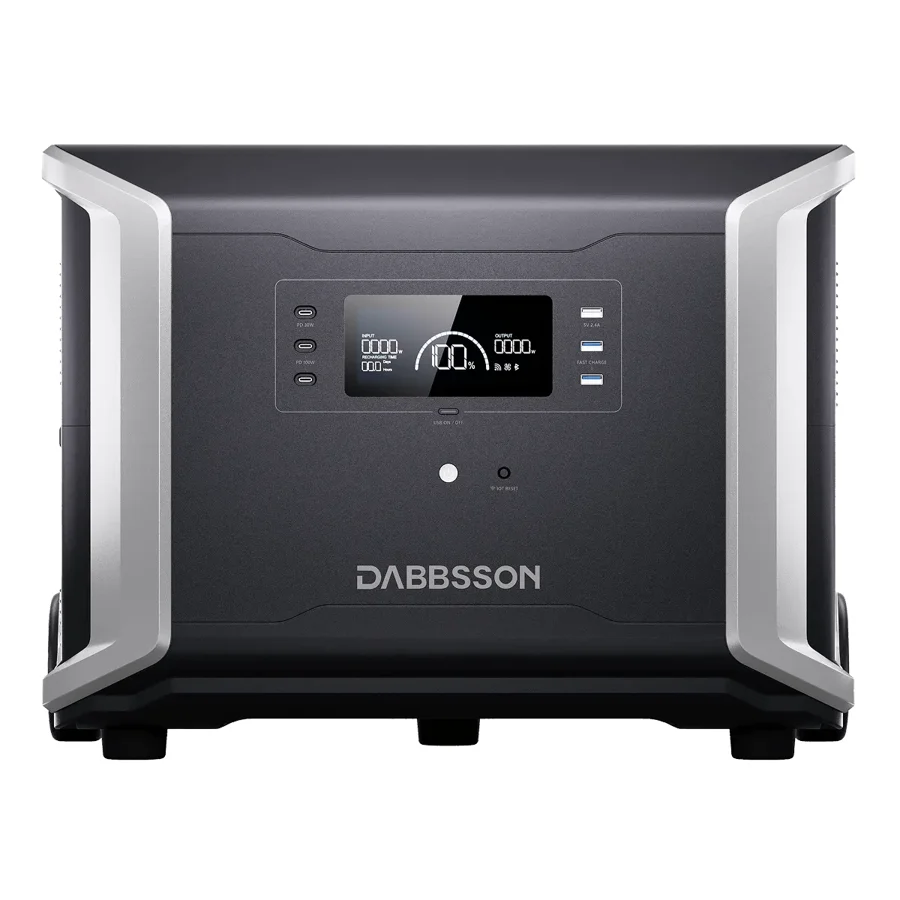
Price: $1,599 • Expandable: 3.43–28.14kWh • Battery: Semi-Solid State LiFePO4 • UPS: Yes • EV Charging • Warranty: 5 years (3+2)
The DBS3500 is the most technically advanced portable power station we've reviewed in 2026. At $1,599, it delivers 3,430Wh of semi-solid state LiFePO4 capacity and 3,600W of continuous output with a staggering 7,000W surge — the highest surge rating in the portable power station category, period. That 7,000W surge handles compressor startup on full-size refrigerators, chest freezers, window AC units, and well pumps without tripping overcurrent protection. If your appliance has a motor, the DBS3500 can start it.
But the headline spec is expandability. The DBS3500 scales from its base 3.43kWh to 28.14kWh using DBS5300B expansion battery packs or by connecting a second DBS3500 in parallel. That's over 8x the base capacity. To put that in perspective: EcoFlow's DELTA Pro expands to roughly 10.8kWh. Jackery's Explorer 2000 Plus reaches about 12kWh. The DBS3500 nearly triples both ceilings. For off-grid living, extended multi-day power outages, or whole-home backup, that expansion depth means you can build a system that actually covers your entire household — not just the essentials.
The 2,400W solar input is the highest in Dabbsson's lineup and among the highest in the market. In strong sun, it charges the DBS3500 from zero to full in roughly 2 hours. The built-in EV charger can push an electric vehicle from 0 to 80% in under 2 hours — a capability no other portable power station in this class offers. UPS mode provides seamless switchover during grid failures, keeping CPAP machines, home servers, and networking gear running without interruption.
The 4,500+ cycle rating to 80% capacity translates to over 12 years of daily use before meaningful degradation — backed by a 5-year warranty (3 standard + 2 via official site registration) and a 15-year battery lifespan rating. That's the longest warranty and lifespan commitment in the portable power station market. The semi-solid state LiFePO4 chemistry isn't just a marketing label: it delivers measurably higher energy density per kilogram than standard LiFePO4, which is why the DBS3500 can pack 3,430Wh into a form factor that weighs roughly the same as competitors with 3,000–3,200Wh.
Buy on Amazon ↗ Check eBay Price ↗ See Home Backup Picks
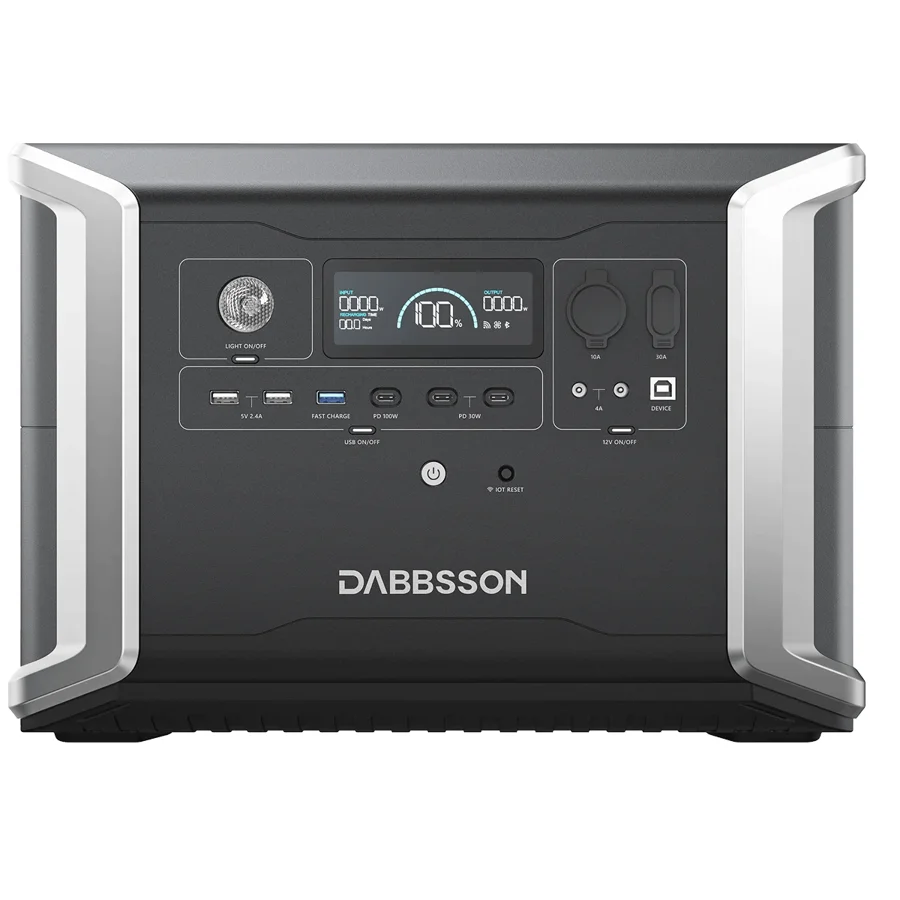
Price: ~$999 • Expandable: Yes (DBS3000B) • Battery: Semi-Solid State LiFePO4 • P-Boost: Up to 3,000W • USB-C: 100W PD • Wall charge: 2 hours
The DBS2300 Plus is the value play that makes the Dabbsson lineup genuinely dangerous to established brands. At roughly $999, you're getting 2,330Wh of semi-solid state LiFePO4 capacity and 2,200W of continuous output with P-Boost pushing it to 3,000W for high-draw appliances. Compare that directly: EcoFlow's DELTA 2 Max offers 2,048Wh and 2,400W output for $1,699. Jackery's Explorer 2000 Plus delivers 2,042Wh and 3,000W output for $2,499. The DBS2300 Plus gives you more capacity than both for 41% to 60% less money.
That's not a rounding error. It's $700 to $1,500 in your pocket for a unit that delivers comparable or superior capacity. The trade-off is in ecosystem polish (EcoFlow's app is better) and brand recognition (Jackery has retail distribution the DBS2300 Plus doesn't). But if you're buying a power station to use, not to admire an app interface, the DBS2300 Plus is the rational choice in the 2,000Wh class.
The 4,000+ cycle semi-solid state LiFePO4 battery outlasts EcoFlow's 3,000+ cycle rating by a full generation. The P-Boost feature is a smart addition — it lets the DBS2300 Plus temporarily handle loads up to 3,000W by intelligently managing output, which means microwaves, hair dryers, and small space heaters are within reach without needing the full 3,000W continuous rating. Expandability via the DBS3000B battery pack gives you room to grow, and the USB-C 100W PD port handles fast-charging laptops directly. Wall charge time of 2 hours from zero to full is competitive with the best in the market.
Buy on Amazon ↗ Check eBay Price ↗ See Under $1,000 Picks
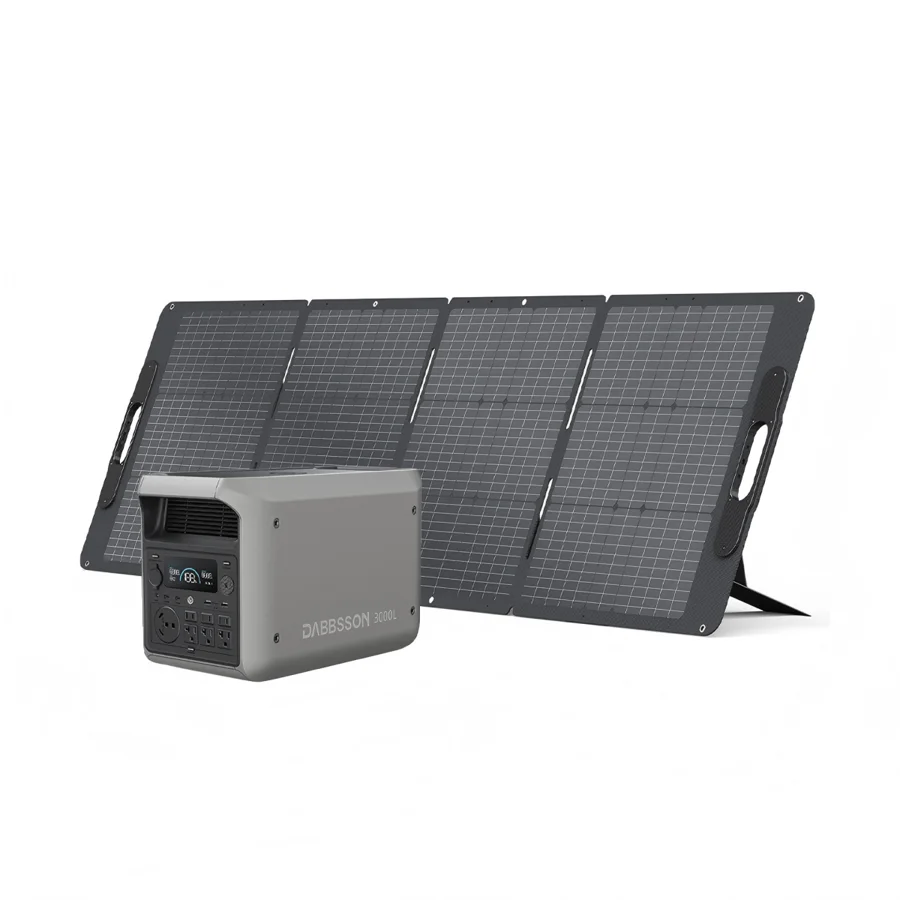
Price: $999 • Battery: Standard LiFePO4 • Series: L (Budget Line)
The 3000L is a game-changer in the budget segment. At $999, it delivers 3,072Wh of LiFePO4 capacity and 3,000W of continuous output — specs that directly compete with units costing $1,500 to $2,500 from EcoFlow, Jackery, and BLUETTI. You're getting flagship-class capacity at a mid-range price point, and that completely reshapes the value equation for buyers who need serious home backup power without the premium price tag.
To put this in context: the DBS3500 offers 3,430Wh for $1,599. The 3000L delivers 90% of that capacity for 38% less money. You lose the semi-solid state battery tech, the 7,000W surge (the 3000L uses standard LiFePO4), the EV charging capability, and the deep expandability. But if your primary need is raw capacity and output at the lowest possible price, the 3000L delivers more watt-hours per dollar than almost anything else on the market right now.
The 3000L sits in the new L series alongside the 2000L ($597), 1000L ($386), 600L ($299), and 300E ($199) — Dabbsson's push to cover every budget tier. For buyers who looked at the ALLPOWERS R3500 (~$1,424 for 3,168Wh) as the value play in the 3,000Wh class, the 3000L undercuts it by $425 while delivering comparable capacity and output. That's a significant margin.
Buy on Amazon ↗ Check eBay Price ↗ See Power Outage Picks
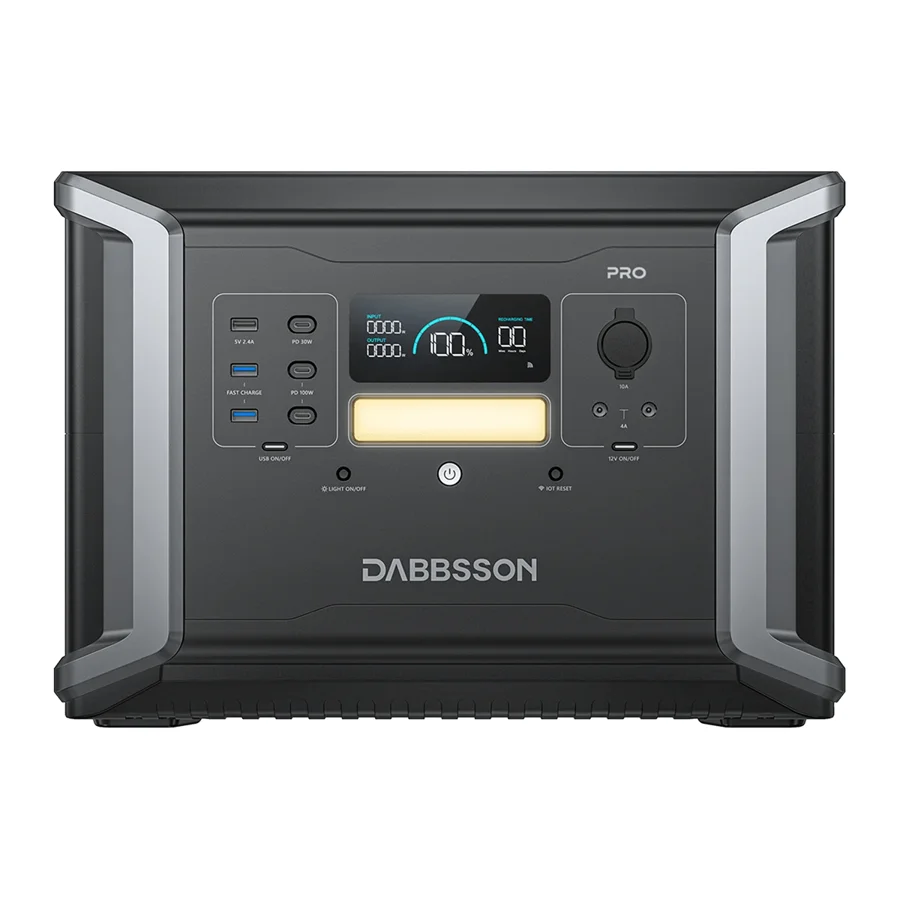
Price: $799 • Capacity: 2,150Wh • Output: 2,400W continuous
The DBS2100 Pro occupies the sweet spot between budget and premium in Dabbsson's lineup. At $799, it delivers 2,150Wh of capacity and 2,400W of continuous output — enough to run a window AC unit, a full-size microwave, or multiple medium appliances simultaneously. The 2,400W continuous rating puts it above the threshold for most household loads that trip up smaller units.
The value proposition is straightforward: for $200 more than the DBS2300 Plus, you get 180Wh less capacity but 200W more continuous output. For $200 less than the 3000L, you get roughly 900Wh less capacity but the DBS series build quality. Where the DBS2100 Pro earns its spot is for buyers who are hard-capped under $800, need serious continuous output (2,400W handles loads that 2,200W can't), and want to stay within Dabbsson's DBS series rather than the newer L line.
For RV and van life users, campers with heavy loads, and homeowners who want a reliable overnight backup without paying flagship prices, the DBS2100 Pro is solid value. The main limitation is the same as every mid-range unit in every brand's lineup: for not much more money, the models above it offer significantly more capability.
Buy on Amazon ↗ Check eBay Price ↗ See RV & Van Life Picks
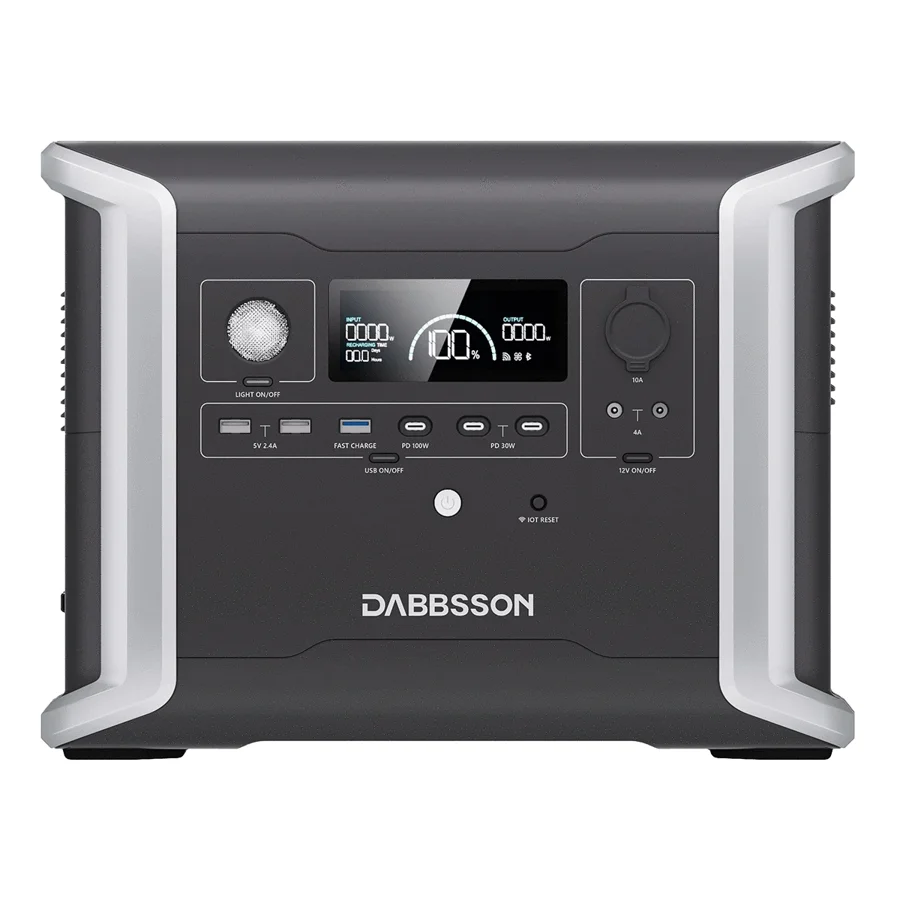
Dabbsson covers the budget tier with four models spanning $199 to $699 — two from the DBS series and two from the L series. Here's the full budget lineup at a glance:
| Model | Series | Capacity | Output | Price | Best For |
|---|---|---|---|---|---|
| DBS1300 | DBS | 1,330Wh | 1,200W | $699 | DBS quality on a budget |
| 1000L | L | 1,008Wh | 1,200W | $386 | Best value under $400 |
| 600L | L | 768Wh | 600W | $299 | Camping & portable power |
| 300E | L | 298Wh | 300W | $199 | Ultra-light travel & devices |
The DBS1300 ($699) is the entry point for Dabbsson's premium DBS series. At 1,330Wh and 1,200W output, it handles fridges, LED lighting, routers, and device charging through overnight outages — the essentials that most households actually need during a storm. For buyers who want DBS series build quality and semi-solid state LiFePO4 chemistry without the flagship price, the DBS1300 delivers.
The 1000L ($386) is arguably the best value in the entire Dabbsson lineup on a pure dollars-per-watt-hour basis. At 1,008Wh and 1,200W output for under $400, it matches the DBS1300's output at nearly half the price. You lose the semi-solid state battery, but the standard LiFePO4 chemistry still offers superior longevity and safety compared to NMC alternatives. For first-time buyers who want serious capability without serious investment, the 1000L is hard to beat.
The 600L ($299) and 300E ($199) round out the lineup for camping, tailgating, and device-charging use cases. The 600L's 768Wh and 600W output handles small appliances and fan/lighting setups. The 300E is the ultralight option at 298Wh and 300W — phones, tablets, laptops, cameras, and drones. Both use standard LiFePO4 and offer the same chemistry-level safety and longevity advantages at entry-level prices.
Browse on Amazon ↗ Browse on eBay ↗
The 2,000Wh class is the most competitive segment in the solar generator market. Here's how Dabbsson's best-value model stacks up against the two biggest names at similar capacity — and why the price gap is almost impossible to justify on specs alone.
| Spec | Dabbsson DBS2300+ | EcoFlow DELTA 2 Max | Jackery 2000 Plus |
|---|---|---|---|
| Capacity | 2,330Wh | 2,048Wh | 2,042Wh |
| Output | 2,200W (P-Boost to 3,000W) | 2,400W | 3,000W |
| Battery | Semi-Solid State LiFePO4 | LiFePO4 | LiFePO4 |
| Cycle Life | 4,000+ | 3,000+ | 4,000+ |
| Expandable | Yes (DBS3000B) | Yes (B230) | Yes (B2000 Plus) |
| Price | ~$999 | $1,699 | $2,499 |
Dabbsson wins on specs, battery technology, and price. EcoFlow wins on ecosystem and app experience. Jackery wins on brand trust and retail distribution. If you're buying based on what the hardware delivers for the money, the DBS2300 Plus is the rational choice. If you're buying based on ecosystem depth, software polish, and the confidence of walking into a store and seeing the product, EcoFlow or Jackery may justify the premium. For deeper comparisons across all brands, use our side-by-side comparison tool or check the home battery backup roundup.
Still not sure which one fits? Match your situation to the use cases below.
Go with the DBS3500 ($1,599). The deepest expandability in the market (up to 28.14kWh), 7,000W surge, EV charging, UPS mode, and 4,500+ cycle semi-solid state LiFePO4. If you need a system that can grow into whole-home coverage, this is it.
Go with the DBS2300 Plus (~$999). 2,330Wh of semi-solid state LiFePO4 with P-Boost to 3,000W — more capacity than EcoFlow and Jackery at 41–60% less money. The value king in the 2,000Wh class.
Go with the 3000L ($999). 3,072Wh and 3,000W output at a price that undercuts every competitor with comparable capacity. If raw watt-hours matter more than premium battery tech or expandability, the 3000L is unbeatable.
Start with the 1000L ($386) for the best value under $400, the 600L ($299) for camping, or the 300E ($199) for ultralight travel. All LiFePO4 with the safety and longevity advantages that chemistry provides.
Still torn between Dabbsson models — or between Dabbsson and another brand entirely? Use our full comparison tool to see every spec side by side, or check the sizing guide to figure out exactly how much capacity your loads demand.
For most buyers, the Dabbsson DBS3500 ($1,599) is the best overall pick — 3,430Wh of semi-solid state LiFePO4, 3,600W output (7,000W surge), expansion to 28.14kWh, UPS, and EV charging. For the best value under $1,000, the DBS2300 Plus (~$999) delivers 2,330Wh with P-Boost to 3,000W — more capacity than EcoFlow and Jackery at a fraction of the price. For raw capacity on a budget, the new 3000L ($999) offers 3,072Wh and 3,000W output. For entry-level needs, the 1000L ($386) is the best value under $400. Use our comparison tool to see all models side by side.
Semi-solid state LiFePO4 is Dabbsson's proprietary battery technology used across its DBS series. It combines the safety and longevity of standard LiFePO4 chemistry with higher energy density by using a gel-like electrolyte instead of a fully liquid one. This reduces internal resistance, improves thermal stability, and allows more energy per kilogram — which is why the DBS3500 can pack 3,430Wh into a form factor similar to competitors with 3,000–3,200Wh. Semi-solid state LiFePO4 maintains the same fire-resistant safety profile and delivers 4,000–4,500+ cycle lifespan to 80% capacity. Dabbsson's L series budget models use standard LiFePO4.
Yes — and the expansion range is the deepest in the portable power station market. The DBS3500 starts at 3,430Wh (3.43kWh) and can scale up to 28,140Wh (28.14kWh) by adding DBS5300B expansion battery packs or connecting a second DBS3500 in parallel. That's over 8x the base capacity. For comparison, EcoFlow's DELTA Pro expands to about 10.8kWh and Jackery's 2000 Plus reaches roughly 12kWh. The DBS2300 Plus is also expandable via the DBS3000B battery pack. Use our sizing guide to figure out how much total capacity your loads actually require.
Dabbsson wins on expandability depth (28.14kWh max vs 10–12kWh from competitors), cycle life (4,500+ on the DBS3500 vs 3,000–3,500 from EcoFlow and ALLPOWERS), battery technology (semi-solid state LiFePO4), warranty (5-year with 15-year battery lifespan), and value (DBS2300 Plus at $999 vs EcoFlow DELTA 2 Max at $1,699 for similar specs). The trade-offs: EcoFlow leads on app ecosystem and AC charging speed, Jackery has the strongest retail presence and brand recognition, and ALLPOWERS offers the lowest absolute prices on some budget models. See our EcoFlow roundup, Jackery roundup, and BLUETTI vs Jackery comparison for detailed head-to-head breakdowns.
Dabbsson offers a 5-year warranty on its DBS series flagship models — 3 years standard plus 2 additional years when you register through the official Dabbsson website. The battery cells are rated for a 15-year lifespan under normal use conditions. The DBS3500's 4,500+ cycle rating to 80% capacity means daily cycling for over 12 years before meaningful degradation. That's the longest combined warranty and lifespan commitment in the portable power station category. The L series budget models (3000L, 2000L, 1000L, 600L, 300E) carry standard manufacturer warranties. For comparison, EcoFlow offers 5 years on some models, Jackery offers 3–5 years, and ALLPOWERS typically offers 3 years.
Compare every Dabbsson model against EcoFlow, BLUETTI, Jackery, ALLPOWERS, and more — side by side, spec by spec.
Compare All Models Not sure what size you need? Read the sizing guide →47 pages. Plain English. No fluff. Covers every major brand, real-world runtime tests, and our top picks for every budget.
No spam. Unsubscribe anytime. We hate junk mail as much as you do.