Your first solar generator shouldn't be complicated. Here are 5 beginner-friendly picks, a plain-English guide to every spec that matters, and a decision framework that gets you to the right unit in 5 minutes.
Quick Answer: The best solar generator for beginners in 2026 is the EcoFlow RIVER 3 Plus ($299). It weighs 8.4 lbs, delivers 286Wh of LiFePO4 capacity and 600W output, charges from a wall outlet in under an hour, and has the best app in the industry. All five picks below use LiFePO4 batteries (3,000+ cycle life), cost under $500, and work straight out of the box — plug in, charge, done. No solar panels required to start.
If spec sheets make your eyes glaze over, this section is for you. Every number below gets used the same way across every brand, every model. Learn these four things and you'll never be confused by a product listing again.
That's it. Capacity tells you how long. Output tells you what. Solar input tells you how fast you recharge off-grid. Battery chemistry tells you how long the unit itself lasts. Everything else — surge watts, X-Boost mode, pass-through charging — is a nice-to-have, not a dealbreaker for your first unit. For the full deep dive, see our sizing guide.
| Rank | Model | Capacity | Output | Solar | Weight | Price |
|---|---|---|---|---|---|---|
| #1 Top Pick | EcoFlow RIVER 3 Plus | 286Wh | 600W | 220W | 8.4 lbs | $299 |
| #2 Best Value | ALLPOWERS VOLIX P300 kit | 256Wh | 300W | 100W panel incl. | — | ~$208.99 |
| #3 Easiest | Jackery Explorer 300D | 288Wh | 300W DC (no AC outlets) | — | 5.5 lbs | ~$209 |
| #4 Step-Up | BLUETTI AC180 | 1,152Wh | 1,800W | 500W | 35.3 lbs | ~$449 |
| #5 Budget | BLUETTI Elite 30 V2 | 288Wh | 600W | — | — | ~$249.99 |
Every model uses LiFePO4 batteries with 3,000+ charge cycles. Every model charges from a standard wall outlet. Solar panels are optional for all of them. Now let's break each one down.
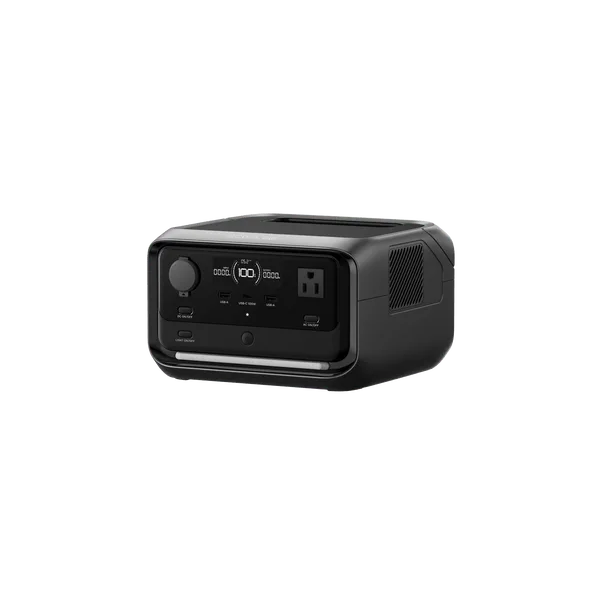
Price: ~$299 • Cycle life: 3,000+ • AC charge: 0-100% in ~55 min • X-Boost: 1,200W surge
If you've never owned a solar generator and want the smoothest entry point, the EcoFlow RIVER 3 Plus is it. At 8.4 lbs, it's the lightest unit on this list — genuinely backpackable, fits in a car door pocket, slides under a seat. The 600W output covers phones, laptops, tablets, LED lights, a portable fan, a mini-fridge, and a CPAP machine without heated humidifier. That covers 90% of what a first-time buyer actually needs.
The killer feature for beginners is speed. Wall outlet charging from 0 to 100% takes under an hour. No other unit at this price recharges that fast from the grid. You can charge it before you leave for a camping trip, forget about it for months, and it'll still hold most of its charge thanks to LiFePO4's low self-discharge rate. The EcoFlow app is the best in the industry — real-time monitoring, remote control, firmware updates — and the X-Boost mode pushes the unit to handle devices up to 1,200W by intelligently adjusting voltage, which means you can run a small coffee maker or blender that would normally be out of range.
The 220W solar input means a single folding panel keeps it topped off indefinitely during camping trips. For camping, van trips, or keeping your CPAP alive on the road, the RIVER 3 Plus is the most capable option at this weight and price. It's also the best "always-charged emergency unit" to keep in a closet for power outages — 55 minutes to full charge means you can top it off after an alert.
Check Price at EcoFlow Buy on Amazon See All EcoFlow Models
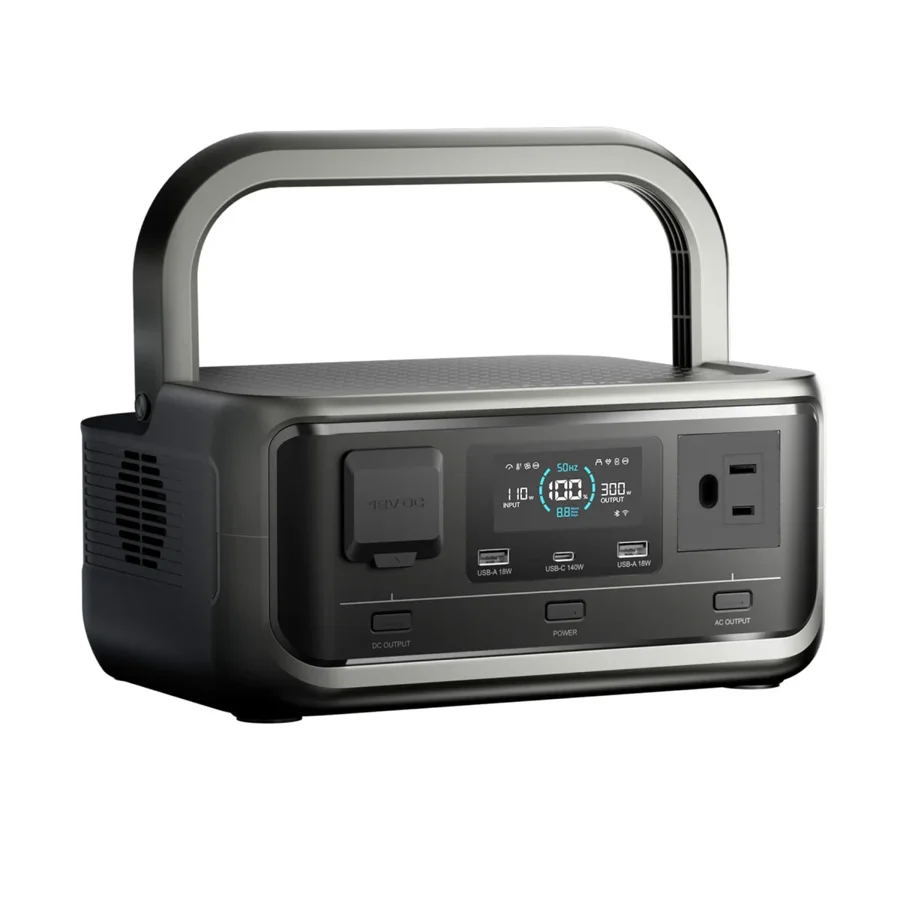
Price: ~$208.99 for the kit with a 100W panel
The ALLPOWERS R600 we used to recommend here is out of stock on ALLPOWERS’ U.S. store, so the VOLIX P300 kit takes the value slot. For $208.99 you get the power station and a 100W solar panel — a complete starter solar setup in one box.
The P300 holds 256Wh of LiFePO4 capacity with 300W of output: enough for phones, laptops, lights, a fan, a CPAP with a DC cable, or a small projector. It recharges from the wall in about an hour, and the included panel lets you top it up anywhere with sun.
If you need to run a mini-fridge or anything over 300W, step up to the AC180 below. See our VOLIX P300 review for hands-on details.
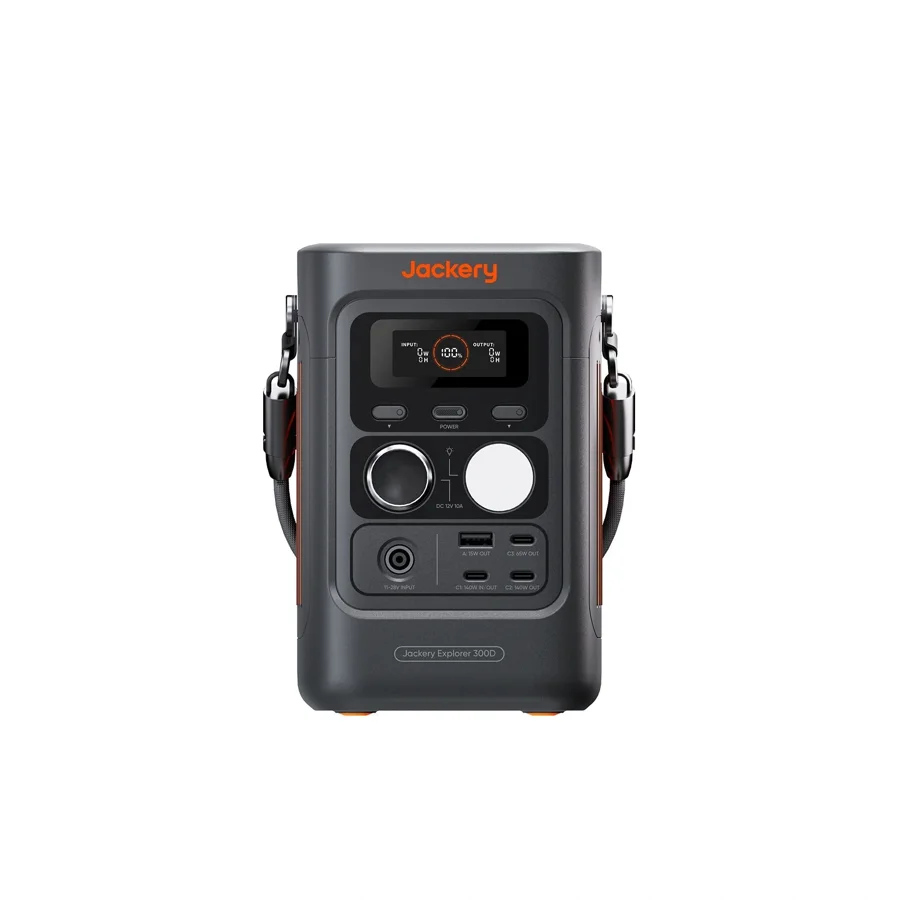
Price: ~$209 (reg. $249) • No AC outlets • Cycle life: 4,000+
Jackery no longer sells the Explorer 300 Plus as a standalone unit in the U.S., so the Explorer 300D replaces it. At 5.5 lbs, it is the lightest unit on this list — light enough for a daypack.
Know this before you buy: the “D” means DC. The 300D has no AC wall outlets. It powers phones, laptops, cameras, lights, and Starlink Mini through USB-C, USB-A, and DC ports, including a built-in 140W USB-C cable.
If you want to plug in anything with a regular wall plug, choose the RIVER 3 Plus or AC180 instead. For electronics-only use, the 300D is the simplest, lightest option at $209.
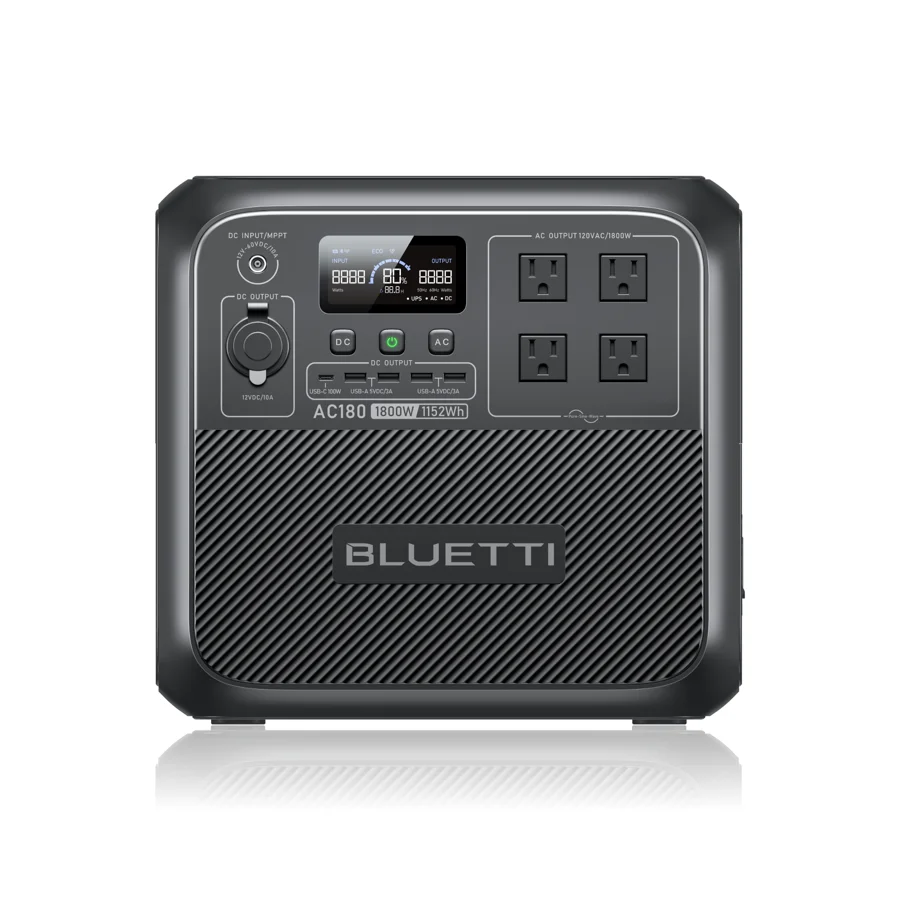
Price: ~$449 • Cycle life: 3,500+ cycles
The BLUETTI AC70 is sold out on BLUETTI’s U.S. store, and the AC180 is the better step-up anyway. For $449 you get 1,152Wh of LiFePO4 capacity and 1,800W of output — enough to run a full-size fridge, a coffee maker, or a microwave.
It recharges to 80% in about 45 minutes from the wall and accepts up to 500W of solar. At 35.3 lbs it is a two-hand carry, so it suits home backup and car camping more than hiking.
If your first solar generator needs to keep a refrigerator running during an outage, this is the pick on this list.
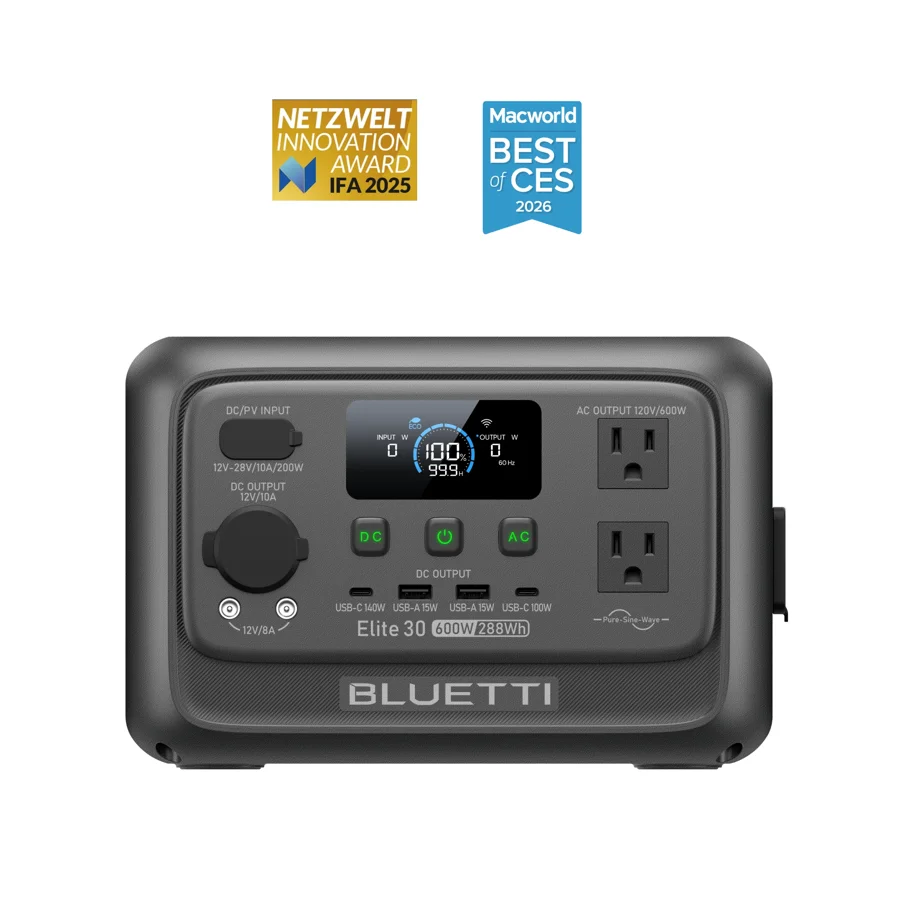
Price: ~$249.99 • UPS: 10ms • Cycle life: 3,000+
The Anker SOLIX C300 DC we recommended here is sold out on Anker’s U.S. store. The BLUETTI Elite 30 V2 replaces it — and unlike the C300 DC, it has standard AC outlets.
You get 288Wh of LiFePO4 capacity and 600W of output, TurboBoost charging to 80% in about 45 minutes, a 140W USB-C port for laptops, and a 10ms UPS switchover that keeps a CPAP or Wi-Fi router running the instant the power drops.
At $249.99 it is quiet (under 30dB at light loads) and simple enough for a first power station that lives in a closet until the next outage.
Match your situation to the right pick:
Go with the EcoFlow RIVER 3 Plus ($299). At 8.4 lbs with 600W output and the best app, it's the most capable travel companion. Pair with a single folding panel for indefinite off-grid power.
Go with the ALLPOWERS VOLIX P300 kit ($208.99). It includes a 100W solar panel, so you can recharge even if the grid stays down. Charge it, put it in a closet, and it’s ready for phones, lights, and a router.
Go with the BLUETTI AC180 ($449). 1,152Wh and 1,800W output handles a full-size refrigerator. The $299 tier can’t. If keeping your food cold during outages matters, spend the extra $150.
Go with the Jackery Explorer 300D ($209). 288Wh of LiFePO4 and a built-in 140W USB-C cable for phones, laptops, and lights — just note it has no AC wall outlets. Need AC outlets? The BLUETTI Elite 30 V2 ($249.99) adds them.
Once you've got your first unit and know what you need, here's your upgrade path:
The EcoFlow RIVER 3 Plus ($299) is our top pick. It weighs 8.4 lbs, delivers 286Wh and 600W output, charges in under an hour from a wall outlet, and has the best app in the industry. For the lowest-cost complete setup, the ALLPOWERS VOLIX P300 kit ($208.99) includes a 100W solar panel. See the full comparison for side-by-side specs.
$200-$300 covers every beginner need. The five picks in this guide range from $199 to $499, and the $299 tier offers the best balance of capacity, output, and value. Don't spend $1,000+ on your first unit unless you already know exactly what you need. Start small, learn your use, then upgrade.
Yes. Every solar generator charges from a standard wall outlet. Solar panels are optional — they extend your off-grid capability and let you recharge from sunlight, but they're not required. Most beginners start by charging from the wall and add solar panels later. See our charging guide for all the ways to charge.
LiFePO4 (lithium iron phosphate) is a type of battery chemistry. It lasts 3,000-4,000+ charge cycles (vs. 500-800 for older NMC lithium-ion), handles heat better, and is safer overall. All five picks in this guide use LiFePO4. In 2026, there's no reason to buy a solar generator with older NMC chemistry.
For phones, laptops, and lights: 300Wh is enough. For CPAP overnight: 400-800Wh. For a full-size fridge during an outage: 1,000Wh+. Most beginners should start with 300Wh, which covers the essentials at $199-$299. Use our sizing guide to calculate your exact needs.
Our #1 pick for beginners is the EcoFlow RIVER 3 Plus — 8.4 lbs, 600W output, full charge in under an hour.
#1 Pick: EcoFlow RIVER 3 Plus Compare All Models Not sure what size you need? Read the sizing guide →47 pages. Plain English. No fluff. Covers every major brand, real-world runtime tests, and our top picks for every budget.
No spam. Unsubscribe anytime. We hate junk mail as much as you do.